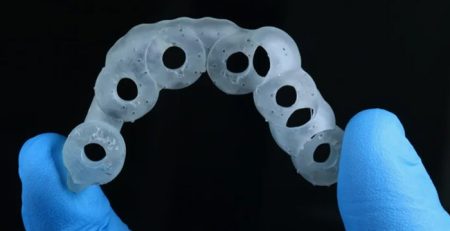





Is it Harmful to Wear Dentures While Sleeping? Should They Be Removed at Night?
Is It Harmful to Wear Dentures While Sleeping?
Is it harmful to wear dentures while sleeping, should dentures be removed at night, and does sleeping with dentures affect oral health? These are among the most frequently asked questions by people who use removable dental prostheses. Especially those who use their dentures comfortably throughout the day may wonder if it is really necessary to remove them when going to bed at night.
Short answer: It is not recommended for most patients to leave full dentures, partial dentures, and many removable implant-supported prostheses, which can be removed and inserted by the patient, in the mouth overnight. Removing dentures at night is generally considered more appropriate for oral tissues to remain free from denture pressure for a certain period, for cleaning the biofilm accumulated on and under the denture surface, and for reducing denture-related oral tissue problems.
However, there is an important distinction here. The word “prosthesis” does not only refer to removable dentures. Crowns, bridges, and some implant-supported restorations are also classified as prostheses and are not removed by the patient. Therefore, the recommendation “dentures should be removed at night” mainly applies to removable prostheses.
In the clinical care recommendations published by the American College of Prosthodontists, patients using removable dentures are advised to remove their dentures during sleep and to clean and store them as recommended. Scientific studies on the subject particularly associate continuous denture use with problems such as the proliferation of Candida microorganisms and denture stomatitis.
For more detailed information about the types of prostheses used in the treatment of tooth loss and the differences between removable and fixed prostheses, you can review the Melsadent Dental Prostheses page.
Should Dentures Be Removed at Night?
If you use a removable denture, removing the denture during sleep at night is the recommended approach in most cases, unless your dentist advises otherwise.
The primary purpose of this is not solely to clean the denture. Throughout the day, the oral mucosa beneath the denture can be exposed to continuous mechanical pressure, friction, temperature changes, food debris, and microorganisms. Keeping the denture out of the mouth for a few hours allows the supporting tissues to rest and facilitates easier care.
Especially in individuals using full dentures, the prosthesis covers a large mucosal surface. When the denture is worn for 24 hours without removal, cleaning this area can become difficult, and a moist microenvironment can form under the denture base.
Therefore, daily denture use should not be evaluated merely as “inserting and removing”; rather, it should be considered holistically to include denture cleaning, oral tissue cleaning, proper overnight storage of the denture, and regular dental check-ups.
Which Types of Dentures Are We Talking About?
When considering the topic of “sleeping with dentures,” the type of prosthesis used must be known.
Removable dentures can be taken out and reinserted by the patient. These include:
- Total dentures or, as commonly known, full dentures,
- Partial removable dentures,
- Clasp dentures,
- Removable dentures with precision attachments,
- Some types of implant-supported overdentures
may be included.
In contrast, crowns, bridges, and fixed implant-supported prostheses that cannot be removed by the patient are not removed at night. Their maintenance method is different.
Those who want to learn about the differences between removable and fixed dentures in detail can review the content: Fixed or Removable? Which Dental Prosthesis Is Right for You?
What is the Most Important Disadvantage of Sleeping with Dentures?
Not removing removable dentures overnight reduces the resting period during which the oral mucosa is free from the prosthesis. Additionally, the biofilm formed on the tissue-contacting surface of the denture continues to be in contact with the oral tissues throughout the night.
Biofilm is a complex microbial structure formed by bacteria, fungi, and various microorganisms. The surfaces of removable dentures, especially acrylic ones, can create suitable areas for microbial attachment.
Therefore, merely rinsing the denture with water may not be sufficient. Regular mechanical cleaning of the denture surface and, when necessary, cleaning with appropriate chemical methods for dentures, is important.
The American Dental Association also recommends daily cleaning of dentures, removal of food debris and microbial load, and using cleaning products according to the manufacturer’s instructions.
Scientific source:
American Dental Association – Denture Care and Maintenance
Can Nighttime Denture Use Cause Denture Stomatitis?
One of the issues that needs to be addressed for individuals using dentures is denture stomatitis. Denture stomatitis is an inflammatory condition that mostly develops in the oral mucosa located under the denture.
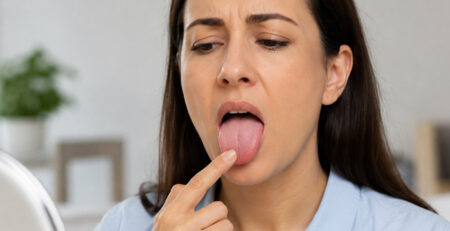
Redness may be observed on the palate, and some patients may experience burning or sensitivity. However, denture stomatitis may not always cause significant pain. Therefore, an individual might continue to use their denture without realizing the problem.
Denture stomatitis is not caused by a single factor. Many factors can influence the risk, such as:
- Inadequate denture hygiene,
- Not removing the denture for a long time,
- Habit of sleeping with dentures,
- Biofilm on the denture surface,
- Proliferation of Candida species,
- Denture incompatibility and trauma,
- Dry mouth,
- General health status
many factors can be effective.
Comprehensive systematic reviews published on denture stomatitis report that continuous denture use, and especially keeping dentures in the mouth overnight, is one of the significant predisposing factors.
Academic source:
A Systematic Review of Denture Stomatitis: Predisposing Factors, Clinical Features, Etiology, and Global Candida spp. Distribution
Does Sleeping with Dentures Cause Fungal Growth in the Mouth?
Candida species play a significant role in a large portion of conditions referred to as “oral thrush” or “oral fungus” among the public. Candida can also be found in the oral environment of healthy individuals. The problem can arise when the microorganism proliferates excessively under suitable conditions.
The tissue-facing surface of a removable denture can create an area where microorganisms can attach. If the denture is not cleaned adequately and is not removed for a long time, microbial biofilm development can be facilitated.
This does not mean that “everyone who sleeps with dentures once at night gets fungus.” The risk can be affected by denture hygiene, the person’s general health status, the amount of saliva, the age and fit of the denture, smoking, medications used, and many other factors.
A systematic review examining how complete dentures are stored overnight states that the approach of removing dentures at night is recommended to reduce denture stomatitis.
Academic source:
The Effect of Overnight Storage Conditions on Complete Denture Colonization by Candida albicans and Dimensional Stability: A Systematic Review
Why is it Important for Gums Under Dentures to Rest?
While natural teeth transmit forces through periodontal tissues and bone, a significant portion of chewing forces, especially with complete removable dentures, is transferred to the mucosa where the denture rests.
Throughout the day, dentures create various forces on the tissues during speech, chewing, and swallowing.
Removing dentures during sleep provides a denture-free period for the mucosa. At the same time, it makes it easier for the person to clean their tongue, palate, gums, and the areas where the denture rests.
If there is constant redness, sensitivity, sores, or pressure spots under the denture, simply removing the denture at night may not be enough. The fit of the denture to the oral tissues should also be checked.
Especially if a previously comfortable denture starts to move, allows food to get underneath it, or causes sores on the gums, it may indicate that the denture’s fit has changed. In such a situation, the details in My Denture is Loose: Why Does It Loosen, What Should Be Done? can be guiding.
What Happens If Dentures Are Not Removed at Night?
Forgetting to remove a denture one night usually does not mean a serious problem will arise on its own. The main point to pay attention to is when sleeping with a denture becomes a continuous habit.
In the long term, continuous denture use can be associated with the following issues in some individuals:
- Redness under the denture,
- Mucosal irritation,
- Denture stomatitis,
- Biofilm accumulation,
- Candida proliferation,
- Bad breath,
- Sensitivity under the denture,
- Difficulty with hygiene
such as these.
However, it is not correct to attribute every redness in the mouth to dentures or fungi. Non-healing lesions, persistently painful areas, or recurrent sores in the mouth should be evaluated by a dentist.
Is Nighttime Denture Use More Important for the Elderly?
Oral hygiene is particularly important for elderly denture users. One reason for this is that saliva production may decrease, manual dexterity may change, different medications may be used, and some individuals may have difficulty performing adequate denture cleaning.
One notable study examining nighttime denture use was conducted on individuals aged 85 and over. The research reported a statistical relationship between nighttime denture use and the incidence of pneumonia in participants who wore dentures during sleep.
There is a very important point here: This result does not prove that nighttime denture use alone directly causes pneumonia. The study shows an observational relationship in a specific elderly age group, and it is not correct to apply the results uniformly to all denture users.
Nevertheless, the research is one of the important pieces of data demonstrating why denture and oral hygiene should not be neglected in elderly individuals.
Academic source:
Denture Wearing During Sleep Doubles the Risk of Pneumonia in the Very Elderly
Does Wearing Dentures While Sleeping Affect Sleep Apnea?
The effect of wearing or not wearing dentures at night on sleep respiration has been investigated in completely edentulous individuals. However, this topic is not as simple as denture stomatitis, and the results of scientific studies are not entirely consistent.
Some clinical studies have reported an increase in the apnea-hypopnea index in completely edentulous patients who sleep with dentures, while other evaluations have found no significant difference.
Therefore, instead of a person with sleep apnea changing their denture wearing habits based solely on general information from the internet, it is more appropriate for them to be evaluated in consultation with their dentist and the physician treating their sleep disorder.
One systematic review on sleep and denture use emphasized that the existing evidence is heterogeneous and that more robust controlled studies are needed.
Academic source:
The Effect of Nocturnal Wear of Dentures on the Sleep Quality: A Systematic Review and Meta-analysis
Should Newly Made Dentures Be Removed on the First Night?
Temporary instructions, different from the general recommendation for nocturnal use, may be given for newly made removable dentures.
Especially with immediate dentures fitted immediately after tooth extraction, the dentist may ask for the denture not to be removed from the mouth during the first few hours or the first night. The reason for this is to control the denture’s effect on the extraction sites and manage healing.
Therefore, for individuals receiving new dentures, the most accurate rule is the specific instruction given by the dentist who delivered the denture.
The general recommendation of ‘Removable dentures must always be removed at night’ does not supersede person-specific instructions given after a surgical procedure.
Can I Sleep with a Clasp Denture?
Clasp partial dentures are removable prostheses that can be taken out by the patient. Therefore, it is appropriate for most patients to remove them at night.
In clasp dentures, the cleaning of the natural supporting teeth is also of great importance. The accumulation of plaque and food debris around the teeth that the clasps touch can lead to cavities and periodontal problems.
Removing the denture at night facilitates a more detailed cleaning of the natural teeth, the denture clasps, and the tissue-contacting surface of the denture.
For the differences between clasp and precision attachment dentures, you can examine the article Precision Attachment Denture or Clasp Denture?.
Can One Sleep at Night with a Precision Attachment Denture?
A significant portion of precision attachment dentures are also designed to be removable by the patient. Therefore, the nightly use, cleaning, and storage of the denture should be arranged according to the recommendations of the dentist who prepared it.
Due to the delicate attachment components, the removal and re-insertion of the denture may differ from ordinary complete dentures. Forcibly removing the denture can damage the retention systems.
How to remove the denture, which product to use for cleaning, and how to protect the attachment mechanisms should be learned during the denture delivery.
Can One Sleep at Night with an Implant-Supported Denture?
Not all implant-supported dentures are the same.
Some implant-supported dentures are fixed restorations that cannot be removed by the patient. These are not removed before bedtime; they remain in the mouth similar to natural teeth, and the area around the implant needs to be cleaned with appropriate methods.
In contrast, some overdenture prostheses connected to implants with locators or similar retainers can be removed by the patient. Their maintenance approach is closer to that of removable dentures, and in most cases, it may be recommended to remove them at night.
Therefore, the answer to the question “I have an implant prosthesis, should I remove it at night?” depends on whether the prosthesis is fixed or removable.
For detailed information about implants and implant-supported restorations, you can visit the Melsadent Implant Treatment page.
How Should Prostheses Be Stored at Night?
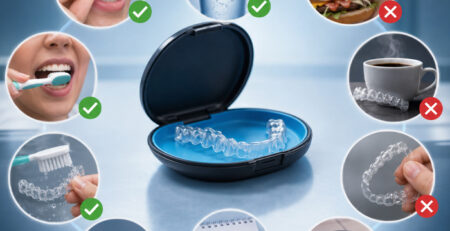
After removing the prosthesis from the mouth, it should not be left casually in a napkin. It is a common occurrence for prostheses wrapped in a napkin to be accidentally thrown into the trash.
The storage method may vary depending on the material of the prosthesis and the manufacturer’s recommendations. While some prostheses need to be prevented from drying out, prolonged contact with some cleaning products may not be suitable for prosthesis materials or metal components.
Therefore:
- First, clean the prosthesis properly.
- Do not use very hot or boiling water.
- Follow the storage method recommended by your dentist.
- If you are using a cleaning tablet, follow the product instructions.
- Ensure that the cleaner used for prostheses with metal parts is appropriate.
- Store the prosthesis in a safe place out of reach of children and pets.
Especially the use of hot water is one of the practices that should be avoided as it can cause deformation in some prosthesis materials.
How Should Prostheses Be Cleaned?
Removing the prosthesis at night is not enough on its own. When the prosthesis is reinserted without being cleaned, the biofilm on its surface can be transferred back into the oral environment.
In daily care, the prosthesis should be cleaned of food debris, and an appropriate brush or cleaning method should be used for the prosthesis.
To prevent the prosthesis from slipping from your hand and breaking during cleaning, it may be useful to fill the sink with water or place a soft towel in it.
Some normal toothpastes may have abrasive properties and thus may not be suitable for all dentures. The cleaner used must be compatible with the denture material.
The American Dental Association recommends daily cleaning of removable dentures and states that denture cleansers should not be used while dentures are worn in the mouth.
Is Cleaning Only the Denture Sufficient?
No. Denture wearers should also clean their oral tissues.
For edentulous individuals, the idea of “I have no teeth, so I don’t need to brush” is incorrect. The tongue, palate, inner cheeks, and tissues that the denture contacts are all part of oral care.
For partial denture wearers, cleaning the remaining natural teeth becomes even more critical. Especially, plaque accumulation on the abutment teeth that support the denture must be controlled.
Natural teeth, interdental spaces, the tongue, and the denture itself should be cleaned together.
Does Dry Mouth Affect Denture Use?
Yes. Saliva is not merely a liquid that wets the mouth; it plays an important role in the protection and cleaning of oral tissues, and in the comfort of the denture.
For denture wearers with dry mouth, the denture-tissue relationship can become more uncomfortable. Complaints of friction, burning, or sensitivity may increase.
Since dry mouth can have various causes such as medication use and systemic diseases, it is important to evaluate individuals experiencing constant dryness.
For detailed information on this topic, you can review the content What is Dry Mouth (Xerostomia)? Symptoms and Treatment.
What to Do If Gums Hurt When Denture Is Removed at Night?
Noticing pain, burning, or sensitivity in the gums after removing the denture may be a sign of trauma caused under the denture throughout the day.
Specifically:
- Recurrent sores,
- Sore spot at a specific point,
- Bleeding,
- Swelling,
- Intense redness,
- Burning sensation,
- Constant pain under the denture,
- Recent loosening of the denture
if present, the denture needs to be evaluated.
It is not recommended for individuals to file, cut, or reshape the irritating part of the denture at home. Even a very minor intervention can alter the denture’s occlusion and its relationship with the oral tissues.
Can Denture Adhesive Be Used and Can One Sleep with Dentures at Night?
Using denture adhesive does not mean that the denture should not be removed at night.
Adhesive can help with the retention of a removable denture in appropriate cases. However, attempting to keep a poorly fitting or progressively loosening denture in the mouth constantly with adhesive can mask the real cause of the problem.
When the denture is removed at night, adhesive residues remaining on the denture and oral tissues should also be properly cleaned.
If the denture used to fit well but now constantly requires adhesive, it may be beneficial to evaluate factors such as changes in jaw tissues, the fit of the denture base, or occlusion.
How Long Should Dentures Be Kept Out of the Mouth?
It is not accurate to provide a single number of hours applicable to everyone. The fundamental approach is to remove removable dentures from the mouth for a specific portion of the day, particularly during sleep.
The clinical guidelines of the American College of Prosthodontists recommend removing removable dentures during sleep.
Source:
American College of Prosthodontists Clinical Practice Guidelines
The type of prosthesis, whether it is newly made, recent surgical procedures, or different clinical conditions may alter this recommendation. Therefore, if there are specific instructions for the individual, the dentist’s recommendation always takes precedence.
What Should Someone Who Is Used to Sleeping with a Prosthesis Do?
People who have been using their prosthesis for years without ever removing it might think, “I haven’t had any problems until now, why should I remove it?”
The absence of visible problems in oral tissues does not mean that the prosthesis is being used ideally. Some inflammatory changes can be painless initially.
Therefore, for individuals who have been using prostheses for many years, the following are important:
- Checking the fit of the prosthesis,
- Evaluating the oral mucosa,
- Checking the prosthesis surface,
- Examining the abutment teeth and implants,
- Evaluating the occlusal relationship
is important.
When transitioning to the habit of removing the prosthesis at night, personalized advice can be obtained from the dentist regarding the cleaning and storage of the prosthesis.
Does the Risk of Nighttime Use Increase as the Prosthesis Ages?
Prostheses are not components of the oral structure that remain unchanged throughout life. Changes can occur in the jaw bone and soft tissues over time.
Therefore, a prosthesis ideally prepared years ago may, over time:
- Loosen,
- Move during eating,
- Allow food particles to get underneath,
- Create excessive pressure in certain areas,
- Cause sore spots,
- Have its occlusal balance change.
Keeping an ill-fitting prosthesis in the mouth throughout the night can increase the duration of tissue exposure. Therefore, it should be evaluated not only whether the prosthesis is clean, but also whether it still fits the oral tissues correctly.
When Should Prosthesis Users Consult a Dentist?
If one of the following symptoms is present, it is beneficial not to postpone a denture check-up:
- A sore or lesion under the denture lasting longer than two weeks,
- Persistent redness,
- Pain or burning sensation,
- Recurrent denture sores,
- Noticeable looseness in the denture,
- The denture lifting while chewing,
- A fracture or crack in the denture,
- Pain or loosening in the supporting teeth,
- Bleeding or sensitivity around the implant,
- Persistent bad breath,
- White or red areas under the denture.
While the source of the problem can sometimes be resolved with a simple denture adjustment, in some cases, a denture reline, repair, or new denture planning may be required.
The Most Common Mistakes Made in Nighttime Denture Use
Some mistakes made by denture wearers in their nighttime care can negatively affect oral health in the long term.
One of the most common mistakes is putting the denture back in without removing and cleaning it. Another mistake is placing the denture in boiling or very hot water.
The use of regular bleach, uncontrolled chemicals, or abrasive products unsuitable for dentures can also damage the denture’s surface or metal parts.
Not cleaning the oral tissues when the denture is removed at night is also a significant oversight. Even if the denture is clean, the biofilm on the tongue and oral mucosa should be removed.
Finally, it is not the correct approach for individuals who have been using the same denture for years to only visit the dentist when the denture breaks. As the oral structure can change over time, periodic check-ups are important.
Is it Harmful to Wear Dentures While Sleeping? Brief Summary
Keeping removable dentures, which can be taken out by the patient, in the mouth overnight is not the recommended method of use for most people.
Removing the denture during sleep:
- Ensures oral tissues remain free from denture pressure,
- Facilitates detailed cleaning of dentures and oral tissues,
- Aids in biofilm control,
- Is an important part of oral care for the prevention of denture stomatitis and Candida-related problems.
In contrast, fixed crowns, bridges, and fixed implant-supported prostheses that cannot be removed by the patient are not removed at night.
However, newly made immediate dentures, dentures used after certain surgical procedures, and custom intraoral appliances may have different usage instructions.
Therefore, the most accurate approach is to know the type of prosthesis used and to follow personalized care recommendations.
At Melsadent Oral and Dental Health Polyclinic, the current condition of removable, fixed, and implant-supported prostheses; the compatibility of the prosthesis with oral tissues, supporting teeth, implants, jaw structure, and oral hygiene are evaluated together to create personalized follow-up and treatment plans.
Frequently Asked Questions
Should dentures be removed while sleeping?
It is recommended that removable full or partial dentures be removed during sleep for most patients. However, your dentist may have different instructions for new dentures, immediate dentures, or special clinical situations.
Will it cause harm if I sleep with my dentures on for one night?
Forgetting just once usually does not mean a serious problem will occur. The main point is that sleeping with dentures should not become a continuous habit. After removing the denture, you can clean it properly and perform your oral care.
Why are dentures removed at night?
Removing removable dentures at night helps keep oral tissues free from denture pressure, allows for better cleaning of the denture and oral mucosa, and aids in biofilm control.
Is it harmful to sleep with dentures?
Continuous and nighttime use of full dentures can create undesirable conditions in terms of denture stomatitis and microbial biofilm. Therefore, it is recommended for most people to remove them at night.
Can sleeping with dentures cause fungal infection?
Nighttime use of dentures alone does not cause fungal infections in everyone. However, continuous denture use, inadequate hygiene, and other risk factors are associated with Candida proliferation and denture stomatitis.
For how many hours should dentures be removed at night?
Instead of a definitive time limit applicable to everyone, it is generally recommended to remove removable dentures from the mouth during sleep. For personalized usage duration, the advice of the dentist who made your dentures should be followed.
Should dentures be placed in water after removal?
The storage method may vary depending on the material of the denture. For some dentures, a moist environment needs to be maintained. Learning from your dentist which solution to use and for how long to store your dentures is the safest approach.
Can dentures be left in a cleaning tablet solution until morning?
The usage duration of every product is not the same. The manufacturer’s instructions for the cleaning tablet must be followed. Especially for dentures with metal parts, ensure that the product used is compatible with the denture material.
Can I brush my dentures with regular toothpaste?
Some regular toothpastes may have an abrasive effect on the denture surface. It is more appropriate to choose a brush and cleaning product suitable for dentures.
Should partial dentures with clasps be removed at night?
Clasped partial dentures belong to the removable prosthesis group and may be recommended to be removed at night for most patients. When the prosthesis is removed, the natural teeth that the clasps touch must also be carefully cleaned.
Can one sleep with a precision attachment denture?
For precision attachment dentures that can be removed by the patient, the approach of removing them at night can generally be applied. However, due to the structure of the attachment systems, your dentist’s instructions regarding how to remove and clean the denture must be followed.
Should an implant-supported prosthesis be removed at night?
If the prosthesis is a removable implant-supported overdenture, it may be recommended to remove it at night. However, fixed implant-supported restorations, which cannot be removed by the patient, are not removed at night.
How should the mouth be cleaned when the prosthesis is removed at night?
Remaining natural teeth should be brushed, interdental spaces cleaned, and attention paid to the hygiene of the tongue and the oral tissues that the prosthesis touches. Being completely edentulous does not mean that oral care is not needed.
Is redness under the prosthesis normal?
Persistent redness should not be considered normal. Denture stomatitis, trauma from the prosthesis, ill-fittingness, or different oral diseases might be present. Especially persistent redness and sores should be evaluated by a dentist.
Why do gums hurt when the prosthesis is removed at night?
This situation may indicate that the prosthesis is applying too much pressure to certain areas during the day. The fit and occlusion of the prosthesis may need to be checked.
Is it correct to sleep with denture adhesive?
The use of denture adhesive does not necessitate keeping the denture in the mouth overnight. Furthermore, the fit of a denture that increasingly requires more adhesive should be checked by a dentist.
How is denture stomatitis diagnosed?
Redness, burning, and sensitivity may be observed in the palate or the area where the denture makes contact. However, some individuals may not experience noticeable symptoms. An intraoral examination is required for a definitive assessment.
Does sleeping with dentures cause bad breath?
Biofilm accumulation on and under the denture surface can contribute to bad breath. Daily denture and oral hygiene are therefore important. Since persistent bad breath can also have different causes, a dentist’s evaluation should be sought if necessary.
Should a newly made denture be removed on the first night?
Not always. Especially with immediate dentures placed immediately after extraction, the dentist may request that the denture not be removed on the first night. In this regard, the instructions of the dentist who placed the denture should be followed rather than general internet information.
I’ve been sleeping with my dentures for years, should I remove them now?
The fact that you haven’t experienced any complaints for a long time does not mean there is no need to evaluate your oral tissues. After checking the fit of your denture and your oral mucosa, your dentist can determine the appropriate overnight use and care routine for you.
Scientific References
American Dental Association – Denture Care and Maintenance
Iinuma T. et al. – Denture Wearing During Sleep Doubles the Risk of Pneumonia in the Very Elderly
The Effect of Nocturnal Wear of Dentures on the Sleep Quality: A Systematic Review and Meta-analysis
Note: This content has been prepared for general informational purposes. Nocturnal denture use, removal duration, and care method may vary depending on the type of denture, the condition of the oral tissues, and the applied treatment. A dental examination is required for a personal diagnosis and treatment plan.