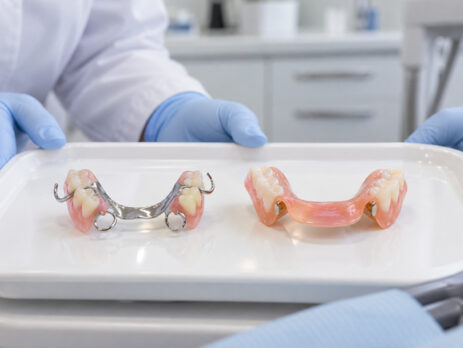
Precision-Attachment Denture or Clasp-Retained Denture? What are the Differences?
Precision Attachment Denture or Clasped Denture?
For individuals experiencing partial tooth loss where fixed bridges or implant treatments are not suitable or preferred, removable partial dentures are one of the important treatment options. At this point, two of the most frequently encountered options for patients are clasped dentures and precision attachment dentures. Although both types of dentures aim to restore chewing function and aesthetic loss caused by missing teeth, their retention methods in the mouth, aesthetic properties, preparation processes, expectations from supporting teeth, and maintenance requirements differ from each other.
Short answer: Precision attachment dentures can provide a more aesthetic solution, especially in cases where visible metal clasps are undesirable, and can offer strong retention in suitable cases. Clasped dentures, on the other hand, can often be a more economical, simpler, and easier-to-repair option. However, there is no single answer to the question “which is better?” that suits everyone. The number and position of remaining teeth, the soundness of supporting teeth, gum and bone condition, occlusal relationships, aesthetic expectations, oral hygiene, and budget should be evaluated together.
In the Dental Prostheses section of Melsadent Oral and Dental Health Polyclinic, removable, partial, and precision attachment dentures are among the treatment options that can be evaluated for different tooth deficiencies.
What is a Clasped Denture?
Clasp prosthesis is one type of removable partial denture used in cases where some natural teeth are present, but missing teeth cannot be restored with a fixed bridge. In dentistry, these structures, also known as removable partial dentures, utilize existing natural teeth for support to help retain the prosthesis in the mouth.
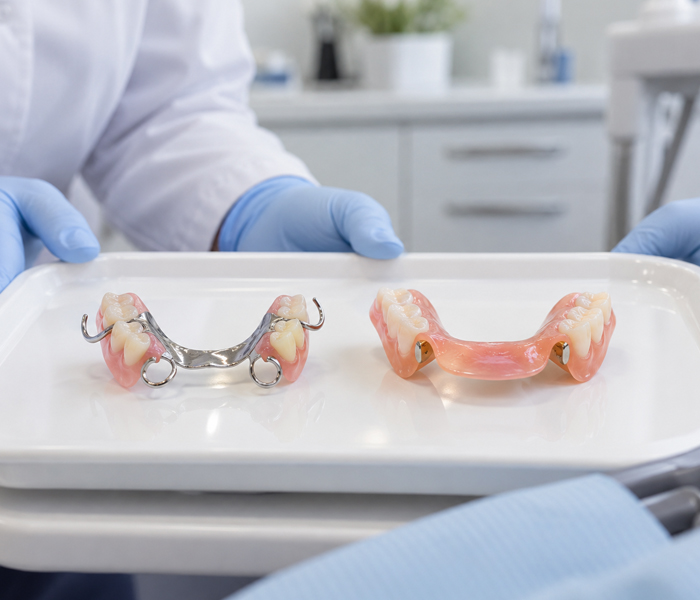
Special metal clasping parts on the prosthesis grip specific surfaces of the abutment teeth, limiting the movement of the prosthesis. Since these retaining structures are commonly referred to as “clasps” among the public, the prosthesis is also known as a clasp denture.
A clasp is not merely a component that holds the prosthesis in place so it doesn’t come out when pulled. In removable partial denture design, support, retention, and stabilization are considered together. The aim is for the prosthesis to appropriately distribute the forces generated during chewing to the natural teeth and the supporting tissues in the edentulous areas.
One of the most important features of clasp dentures is that they are a relatively classic treatment method that has been used for many years. With proper planning, they can be applied to many different types of tooth loss. However, metal clasps placed on abutment teeth, especially in the anterior or lateral regions, may be noticeable in some patients during smiling.
What is a Precision Attachment Denture?
A precision attachment denture is also a removable partial denture that can be inserted and removed by the patient. Its main difference from a clasp denture is that the connection providing retention for the prosthesis in the mouth is achieved with special attachment systems instead of traditional metal clasps.
These systems can often be likened to a male-female mechanism that interlocks or overlays. The retaining part on one section of the prosthesis combines with the supporting structure in the mouth, allowing the prosthesis to seat in a specific direction and remain stable during use.
Since the precision attachment mechanism can be hidden within the prosthesis or in the region associated with restorations on the abutment teeth, it may be possible to reduce or completely eliminate the classic visible metal clasps. For this reason, prostheses with precision attachments are particularly sought after by individuals with high aesthetic expectations.
However, a precision attachment prosthesis should not be considered solely as a “prosthesis without visible clasps”. For the system to be usable, appropriate abutment teeth must be present, the periodontal condition of the teeth must be adequate, the necessary vertical space for the prosthesis must be available, and occlusal forces must be distributed in a controlled manner.
What is the Main Difference Between a Precision Attachment Prosthesis and a Clasp Prosthesis?
The main difference between the two prostheses is the retention mechanism. In clasp prostheses, the retainers that help the prosthesis stay in the mouth are hook-like structures that grip around the abutment teeth. In precision attachment prostheses, retention is provided by special connection systems that operate more discreetly.
| Feature | Precision Attachment Prosthesis | Clasp Prosthesis |
|---|---|---|
| Retention | Special precision attachment system | Clasps gripping natural teeth |
| Aesthetics | Metal retainer is usually not visible externally | Clasps may be visible in some areas |
| Preparation | More detailed planning and in some cases abutment tooth restoration may be required | Can be applied more simply depending on the case |
| Cost | Generally higher | Generally more economical |
| Repair and Adjustment | May require more specialized procedures depending on the retention system | May be easier in most cases |
| Patients with high aesthetic expectations | Can provide a significant advantage | Visible clasps can be a disadvantage |
| Maintenance | Precision attachments need to be cleaned separately | Careful cleaning around the clasp and abutment teeth is required |
Is a Precision Attachment Denture More Aesthetic?
One of the most significant advantages of precision attachment dentures over clasp-retained dentures is aesthetics. Especially when metal clasps need to be placed on visible premolars or canines during a smile, clasp-retained dentures can be aesthetically bothersome for some people.
In precision attachment systems, the ability to conceal the attachment mechanism within the denture and abutment structure can significantly reduce the visibility of metal clasps. This way, a person might prefer that it’s less noticeable they are wearing a removable denture when speaking or smiling.
However, the aesthetic success of a denture is not solely dependent on the invisibility of the clasps. The shape and color of the prosthetic teeth, the harmony of the gum-colored material with natural tissues, lip support, the alignment of the teeth, and the visible area during a smile also determine the outcome.
Which One Provides Better Retention?
Regarding retention, it is not appropriate to draw a definitive conclusion based solely on the type of denture. A well-planned clasp-retained denture can provide sufficient retention and stability. Similarly, strong retention can also be achieved with dentures prepared with correct case selection and appropriate precision attachment mechanisms.
A clinical study published in 2025 comparing attachment-retained and clasp-retained removable partial dentures reported that precision attachment dentures could show higher retention and patient satisfaction in the initial months. The study can be accessed via PubMed.
However, this result does not mean that “precision-attachment dentures provide better retention in every patient.” The success of the denture is significantly influenced by the position of the abutment teeth, the design of the denture, the jaw structure, the length of the edentulous area, occlusal forces, and the denture’s adaptation over time.
Which One Provides Better Chewing?
One of the main goals of both types of dentures is to reduce the chewing loss caused by missing teeth. Chewing performance may not immediately reach maximum levels during the adaptation period to a new denture. The tongue, cheek muscles, and the masticatory system adapt to the presence of the new denture over time.
A clinical study published in 2025 reported that both clasped and attachment-retained removable partial dentures showed improved chewing efficiency as their usage time progressed. Although some advantages were observed in the precision-attachment group during the three-month evaluation, researchers emphasized that time was a significant factor for both denture groups. Research details can be examined in the PubMed scientific database.
Therefore, not being able to chew hard foods in the same way as with natural teeth on the first day of wearing a denture is not, by itself, an indication of failure. It is important to adhere to the adaptation process recommended by the dentist and to attend the necessary check-up sessions.
Are Precision-Attachment Dentures More Comfortable?
In suitable cases, patients may find that precision-attachment dentures sit more securely in the mouth. Particularly, the reduced concern about the denture moving while eating or speaking can positively impact user comfort.
In small-scale clinical studies comparing clasp-retained and attachment-retained dentures on the same individuals, advantages have been reported for attachment-retained dentures in terms of aesthetics, stability, and overall patient satisfaction. One of the studies on this topic is a comparative study published in PubMed.
However, comfort varies from person to person. Discomfort may occur regardless of the retaining system if the denture does not fit properly in the mouth, if the bite is high, if the denture edges irritate the tissues, or if there are problems with the abutment teeth.
Are Teeth Cut for Precision Attachment Dentures?
The answer to this question depends on the precision attachment system to be used and the condition of the existing teeth. In a significant portion of traditional precision attachment dentures, crown or bridge-like restorations may need to be prepared on the abutment teeth. A part of the precision attachment can be designed in connection with these restorations.
Therefore, whether a completely sound abutment tooth needs to be prepared should be evaluated separately in the treatment plan. The approach may be different for teeth that previously had large fillings, need a crown, or already have a prosthetic restoration planned.
Since there are different attachment designs today, it is not correct to say that all precision attachment dentures require the same amount of tooth preparation. Which system will be applied can only be determined after an intraoral examination and radiographic evaluation.
Are Sound Teeth Cut in Clasp Dentures?
In clasp-retained removable partial dentures, abutment teeth do not necessarily need to be reduced for a full crown. However, limited adjustments may be necessary on some tooth surfaces to ensure the proper functioning of the denture’s support and guiding elements.
In some cases, crowning existing teeth or performing other restorative procedures may also be part of the treatment plan. Therefore, a definitive generalization such as “no teeth are treated in a clasp prosthesis” is not correct.
Should Abutment Teeth Be Sound for Precision Attachment Dentures?
Yes. The evaluation of the periodontal and structural condition of the abutment teeth is extremely important for the success of precision attachment dentures. This is because some of the forces generated during chewing are borne by these teeth and the surrounding supporting tissues.
If the abutment tooth has advanced bone loss, significant mobility, untreated decay, a root problem, or active periodontal disease, these issues may need to be evaluated first.
Patients with gum and supporting tissue problems can find detailed information about periodontal treatments on Melsadent’s Gum Treatment (Periodontology) page.
Do Clasp Dentures Harm Abutment Teeth?
The purpose of a properly designed, regularly checked, and well-cleaned removable denture is to complete the function of missing teeth by protecting the remaining teeth. However, plaque accumulation around the denture and insufficient oral hygiene can increase the risk of decay and periodontal problems in the abutment teeth.
Areas where clasps are located should be cleaned with particular care. Using the denture day and night without removal, accumulation of food debris under the denture and around the abutment teeth, or long delays in control appointments can set the stage for problems.
Clinical studies evaluating the periodontal effects of clasp and attachment-retained dentures on abutment teeth show that oral hygiene and regular follow-up are important. One of the relevant studies is a periodontal health study published on PubMed.
Does Precision Attachment Denture Harm Gums?
Similar to other removable dentures, precision attachment dentures are in contact not only with the abutment teeth but also with the oral mucosa and the underlying bone tissue in some areas. The tissue surface of the denture must fit perfectly in the mouth, and chewing forces must be evenly distributed.
Changes in the jaw bone and gum tissues over time can reduce the harmony between the denture and the tissues. In this case, a denture that was initially comfortable to use may start to move, create sore spots, or lift while eating in later years.
Individuals experiencing such a problem can also review Melsadent’s My Denture Is Loose: Why Does It Loosen, What Should Be Done? content.
Do Precision Attachment Dentures Loosen Over Time?
Precision attachments are mechanical parts and are subjected to continuous insertion-removal movements and chewing forces. Depending on the system used, it is possible for the retaining components to wear down over time and for the initial retention to decrease.
This does not always mean that the denture needs to be completely replaced. In some precision attachment systems, worn or less retentive components such as matrices, rubber, or similar parts can be replaced or adjusted. Which procedure can be performed depends on the type of system used.
A systematic review published in 2026 reports that various attachment systems used in removable dentures can show successful short-term results, but technical complications may arise in the long term. Mechanical problems such as detachment of the connection or decreased retention have been specifically reported. The current review can be accessed via PubMed.
Do Clasp Dentures Loosen Over Time?
The retention of clasp dentures can also change over time. Changes in the elastic properties of the clasp, reduced adaptation of the denture to oral tissues, changes in abutment teeth, or bone remodeling of the jaw can cause the denture to feel more mobile.
Attempting to tighten the clasp with pliers or a similar tool by the patient is incorrect. Metal bent uncontrollably can fatigue, break, or apply inappropriate force to the abutment tooth. A denture with reduced retention needs to be evaluated by a dentist.
What is the Lifespan of Precision Attachment Dentures?
It is not possible to give a definitive lifespan applicable to everyone for precision attachment dentures. The denture’s lifespan depends on the health of the abutment teeth, oral hygiene, denture design, material used, an individual’s chewing forces, teeth clenching habits, regular check-ups, and maintenance of the precision attachment system.
Even if the denture base remains usable for a long time, some parts of the attachment may require earlier maintenance or replacement. Similarly, due to changes in oral tissues, the intaglio surface of the denture may need relining.
Systematic studies investigating the long-term clinical success of attachment systems have reported highly variable results among different systems. A systematic review evaluating Kennedy Class I and II cases examined studies involving 1,357 patients and reported that there was insufficient evidence to clearly demonstrate the superiority of a single attachment system in all situations. The scientific publication can be accessed here.
What Are the Disadvantages of Precision Attachment Dentures?
- Their preparation may require more detailed prosthetic planning compared to clasp dentures.
- In some systems, crowns or similar restorations may be required on the abutment teeth.
- Laboratory stages can be more extensive.
- Their cost may be higher than classic clasp dentures.
- Precision attachment parts may wear out over time.
- Repair and part replacement may depend on the characteristics of the system used.
- It may not be suitable for every patient with insufficient abutment teeth.
- Requires good oral hygiene and regular check-ups.
What Are the Advantages of Clasp Dentures?
One of the most important advantages of removable clasp dentures is their applicability in a wide variety of partial tooth deficiencies. They can provide a functional solution in many cases where suitable abutment teeth are present.
Compared to precision attachment systems, laboratory and clinical stages can be simpler in some cases. Furthermore, the repair of problems such as clasp breakage or loss of retention that may occur can often be planned more easily.
Economically, clasp dentures are generally a more accessible option than precision attachment dentures. This feature can be important for individuals seeking removable denture treatment but not preferring more complex prosthetic systems.
What is the Biggest Disadvantage of Clasp Dentures?
The most frequently cited disadvantage of clasp dentures is aesthetics. Depending on the position of the abutment tooth, the metal clasp may be visible during smiling or speaking.
Especially in teeth close to the anterior region, the visibility of the clasp can be significant for patients with high aesthetic expectations. However, it should not be assumed that clasps will be prominent in every clasp denture. The position, design, and smile line of the clasp affect its visibility.
How Are Precision Attachment Dentures Cleaned?
For precision attachment dentures to be used trouble-free for a long time, both the denture and the supporting structures in the mouth must be cleaned regularly. After the denture is removed, food debris on its surface should be removed using an appropriate denture brush.
The area around the precision attachment components is particularly important. Plaque accumulation in these areas can negatively affect the health of the supporting teeth and gums. According to the dentist’s recommendation, interdental brushes, dental floss, or auxiliary products suitable for denture care can be utilized.
Cleaning dentures with boiling water is not advisable, as very hot water can cause deformation in denture materials. Additionally, abrasive cleaning agents can damage the denture’s surface.
How Are Clasp Dentures Cleaned?
One of the areas that requires the most attention with clasp dentures is the natural tooth surfaces that the clasps contact. Prolonged presence of plaque and food debris in these regions can pose a risk for cavities and gum problems.
After the prosthesis is removed from the mouth, both the prosthesis and natural teeth should be cleaned separately. Brushing only the prosthesis is not enough. Especially the area around the abutment teeth and between the teeth are an important part of daily oral hygiene.
Can One Sleep at Night with an Attachment-Retained or Clasp Denture?
Although the nighttime use of removable dentures is evaluated according to the individual’s oral structure and specific clinical condition, it may be recommended for most patients to remove the denture for certain periods to allow the oral tissues to rest.
However, the times at which the denture should be removed, how it should be stored when removed, and the cleaning method may vary depending on the type of denture used. Therefore, it would be more appropriate for the patient to follow the dentist’s care instructions for their specific denture.
Who is Suitable for Attachment-Retained Dentures?
Attachment-retained dentures can be considered especially for patients with partial tooth loss who need to use a removable denture but do not want the metal clasps to be visible.
It is important for the ideal candidate to have a sufficient number of abutment teeth in appropriate positions. Adequate root and bone support for the abutment teeth, control of active gum disease, and the patient’s ability to maintain oral hygiene are also considered in treatment planning.
Furthermore, there must be sufficient prosthetic space in the mouth for the placement of the attachment and the denture base. Very short clinical crowns or limited occlusal space can make the application of some attachment systems difficult.
Who is Suitable for Clasp Dentures?
Clasp-retained removable partial dentures can be considered for patients who have one or more natural teeth but whose all missing teeth cannot be adequately replaced with a fixed bridge.
Especially in cases with a long edentulous area in the posterior region or when there is no abutment tooth at the end of the dental arch, removable partial dentures may be one of the options.
However, the soundness and periodontal support of the remaining teeth must still be evaluated. It is not enough for the tooth where the clasp will be placed to merely be present in the mouth; it must be capable of withstanding the forces coming from the prosthesis.
Implant or Precision-Attachment Denture?
In some cases of partial edentulism, implant-supported fixed or removable prostheses can also be an alternative. In implant treatment, different prosthetic options can be planned by placing implants, which act as artificial tooth roots, in the missing tooth area.
The suitability of an implant depends on many variables such as the quantity and quality of the jaw bone, systemic health status, smoking habits, oral hygiene, the position of missing teeth, and economic factors.
Patients considering implant treatment can obtain detailed information about treatment options from Melsadent’s Implant Treatment page.
Just as the inability to apply an implant does not automatically mean that a precision-attachment denture is the correct option, the possibility of an implant does not necessarily mean that an implant must be preferred. The treatment plan should be prepared individually for each person.
Is a Precision-Attachment Denture or a Clasp Denture Cheaper?
Generally, classic clasp-retained removable partial dentures can be more economical than precision-attachment dentures. The use of special attachment components in precision-attachment dentures, the potential need for additional prosthetic restorations on supporting teeth, and more extensive laboratory procedures can increase the cost.
However, the cost of a prosthesis is not solely determined by its retentive mechanism. The number of missing teeth, procedures to be performed on supporting teeth, materials to be used, additional treatments, and the design of the prosthesis can all alter the total cost. Therefore, comparing the two treatments based on a standard price without an examination can be misleading.
Can a Precision-Attachment Denture Be Repaired?
It is possible to repair problems occurring in many precision-attachment dentures; however, the procedure to be applied varies depending on the mechanism used. In some systems, if the part providing retention wears out, it may be sufficient to replace the relevant part.
In cases such as the fracture of the denture base, separation of a denture tooth, or decreased adaptation of the denture to oral tissues, different laboratory procedures may be required.
If the precision attachment is completely damaged or a serious problem occurs in the abutment tooth, the existing denture may need to be redesigned. For this reason, it is important for users of precision-attachment dentures to know the type of system and not to neglect their regular check-ups.
Why is Control Important After Denture Placement?
Removable denture treatment does not completely end with the delivery of the denture to the patient. After a new denture is placed, pressure or sore spots may develop in some areas. Occlusal relationships and denture stability may need to be checked.
In the long term, the condition of the abutment teeth, gums, denture base, clasps, or precision attachments should be evaluated. It should not be considered normal for a previously well-fitting denture to suddenly start loosening, lift during eating, or cause pain around the abutment tooth.
Can Removable Dentures Improve Quality of Life?
Missing teeth do not only cause an aesthetic problem. They can also lead to issues such as reduced chewing function, changes in speech, avoidance of certain foods, and loss of self-confidence in social settings.
In systematic reviews and meta-analyses evaluating the effects of removable partial dentures on quality of life, it has been reported that an improvement in oral health-related quality of life may be observed after treatment, especially in the short term. However, it is emphasized that the quality of existing scientific evidence is limited and more research is needed for long-term outcomes. The relevant systematic review can be examined via PubMed.
Are Precision Attachment Dentures or Clasp Dentures Better?
The most accurate answer to this question depends on the patient’s oral structure. Precision attachment dentures can offer significant advantages, especially in individuals with high aesthetic expectations and suitable abutment teeth. Clasp dentures, on the other hand, can be the right choice for many patients due to their simpler, more economical, and versatile applicability in various clinical situations.
Scientific research shows results indicating that attachment-retained dentures can provide higher retention and satisfaction in some patient groups. However, long-term clinical success depends not only on the type of retainer but also on the design of the denture, the health of the abutment teeth, oral hygiene, masticatory forces, and regular check-ups.
Therefore, instead of choosing precision attachment dentures solely with the thought of “no clasps showing” or clasp dentures merely because they are more economical, a comprehensive prosthetic evaluation should be performed.
What Factors are Considered When Choosing Between Precision Attachment Dentures and Clasp Dentures?
The dentist first evaluates the number, position, and soundness of the remaining teeth in the mouth. Subsequently, the bone and gum tissues supporting the teeth, the length of edentulous areas, the occlusal relationships of the upper and lower jaws, and the distribution of masticatory forces are examined.
The teeth visible during a smile can also influence treatment selection. If the abutment tooth where a clasp needs to be placed is within the smile line, a precision attachment design can provide an aesthetic advantage.
The patient’s ability to clean the prosthesis, existing systemic diseases, their ability to attend control sessions, and economic expectations should also be included in the evaluation.
The aim in modern prosthetic treatments is not only to place teeth in missing spaces but to create a functional, cleanable oral structure that meets the patient’s expectations, while preserving the remaining natural teeth and supporting tissues as much as possible.
Removable Prosthesis Planning at Melsadent
When planning the treatment of missing teeth at Melsadent Oral and Dental Health Polyclinic, the condition of the remaining teeth in the mouth, gum and bone support, the distribution of missing teeth, and the patient’s aesthetic and functional expectations can be evaluated together.
It is important not to decide based on a single factor when choosing between classic partial dentures, precision attachment dentures, or implant-supported alternatives in suitable cases. More information about current prosthetic treatments can be obtained from Melsadent’s Dental Prostheses page.
Those who want to learn about the application areas of digital methods and modern dental technologies in prosthesis planning can also examine the Digital Dentistry page.
Frequently Asked Questions
Does a precision attachment denture have clasps?
One of the main advantages of precision attachment dentures is the ability to use more hidden connection systems instead of the visible metal clasps found in classic partial dentures. Depending on the prosthesis design used, there may be no visible clasp from the outside.
Can a precision attachment denture be removed and reinserted?
Yes. A precision-attachment denture is not a fixed bridge. It belongs to the group of removable dentures that can be removed and reinserted by the patient.
Does a precision-attachment denture stay in place like a fixed denture?
A properly designed precision-attachment denture can provide strong retention, but it is ultimately a removable denture. It should not be considered the same structure as a natural tooth or a completely fixed restoration.
Does a precision-attachment denture come out while eating?
A properly designed denture that maintains its retention is not expected to consistently come out during normal chewing. If the denture starts to move significantly while eating, the retainers or the denture-tissue fit should be evaluated.
Does a clasp denture move while eating?
With clasp dentures, a certain amount of movement may be observed depending on the denture’s support type; however, noticeable looseness, lifting, or constant displacement of the denture is a situation that needs to be evaluated.
What should be done if a precision-attachment denture becomes loose over time?
The cause of the looseness is determined. If there is wear on the precision attachment part, adjustment or part replacement can be done depending on the system used. If the problem stems from a decrease in the denture’s fit with the oral tissues, a different procedure may be necessary.
Can a precision-attachment denture be made for every missing tooth?
No. It requires the presence of adequate abutment teeth, sufficient periodontal support, availability of the necessary space for the denture, and occlusal relationships suitable for the treatment.
Is a clasp denture or a precision-attachment denture more durable?
Durability does not solely depend on the type of retainer. The design of the denture, the material used, chewing forces, maintenance, abutment teeth, and regular check-ups are important factors determining its lifespan.
Is a precision-attachment denture more expensive?
Generally, yes. The cost can be higher than a classic clasp-retained denture due to special attachment mechanisms, additional laboratory stages, and in some cases, restorations required on the abutment teeth.
Is it comfortable to eat with a precision attachment denture?
Significant improvement in chewing function can be achieved with a properly planned denture. A certain adaptation period may be required to get used to the new denture, and it may be advisable to start with softer foods during the initial period.
Does a clasp-retained denture cause tooth decay?
The clasp itself should not be considered a direct cause of tooth decay. However, plaque accumulation around the clasp and denture, along with inadequate oral hygiene, can increase the risk of decay. Therefore, careful cleaning of the abutment teeth is important.
Does a precision attachment denture cause gum recession?
Correct design and regular maintenance are primary goals. There are many causes of gum recession. If there is suspicion of a periodontal problem in the abutment teeth or traumatic force due to the denture, a clinical evaluation should be performed.
Can implants be placed instead of a precision attachment denture?
Implant-supported treatments can be an alternative for some patients. However, the decision for implants cannot be made without evaluating sufficient bone quantity, general health status, oral hygiene, and other clinical factors.
Is gum treatment required before getting a precision attachment denture?
If active gum disease is present, the periodontal problem may need to be controlled before the denture is made. This is because the long-term success of the denture is directly related to the health of the abutment teeth and the surrounding tissues.
Precision Attachment Denture or Clasp-Retained Denture?
In the treatment of partial tooth loss, both precision-attachment and clasp-retained removable dentures are functional options when the right patient and the right design are chosen. While precision-attachment dentures can offer advantages in terms of reducing visible clasps and meeting aesthetic expectations, clasp-retained dentures can be a more economical, classic, and in many cases, easier-to-apply solution.
Current scientific studies show that precision-attachment systems can provide advantages in retention, aesthetics, and patient satisfaction in some patient groups. However, scientific data does not support one type of denture being superior for all patients.
The most appropriate denture choice should be made by evaluating the condition of remaining teeth and gums, jaw bone, distribution of missing teeth, occlusion, aesthetic expectations, hygiene habits, and long-term maintenance requirements of the treatment.
At Melsadent Oral and Dental Health Polyclinic, an individualized treatment plan can be created after an intraoral examination and necessary imaging to determine the appropriate denture option for the individual.
Note: This content is for general informational purposes. Suitability for precision-attachment dentures, clasp-retained dentures, or other missing tooth treatments can only be determined after a dental examination.