



What to Do If a Permanent Tooth Emerges Before the Baby Tooth Falls Out?
If a Permanent Tooth Erupts Before the Milk Tooth Falls Out
When checking your child’s mouth, you might notice a new tooth erupting right behind a milk tooth, even though the milk tooth hasn’t fallen out yet. This situation, particularly common in the lower front teeth, can be surprising for parents. However, it doesn’t always indicate a serious dental development problem.
Sometimes there can be timing differences between the eruption of permanent teeth and the shedding of milk teeth. What’s important is how loose the existing milk tooth is, the position of the new tooth, and whether there is enough space in the jaw. While observation might be sufficient for some children, others may require dental intervention.
Is It Normal for a Permanent Tooth to Erupt Before the Milk Tooth Falls Out?
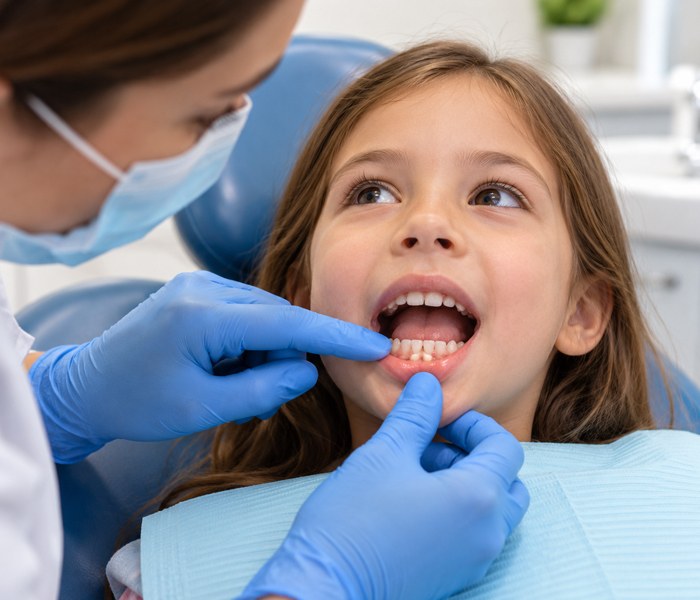
The eruption of a permanent tooth behind a milk tooth is a situation that can be encountered, especially in children during the mixed dentition period. It is generally seen in the lower front incisors. Because it temporarily creates the appearance of two rows of teeth in the mouth, it is also colloquially referred to as “shark tooth”.
This appearance alone does not mean a permanent disorder. The milk tooth may eventually loosen and fall out, and the new tooth may move into the correct position. However, if the milk tooth is firmly in place or if the permanent tooth is erupting noticeably from the wrong position, an examination is recommended.
Why Does a Permanent Tooth Erupt Behind a Milk Tooth?
In normal tooth eruption, physiological resorption occurs in the root of the primary tooth as the permanent tooth develops. This causes the primary tooth to loosen and fall out naturally. However, if the permanent tooth erupts from a different direction, root resorption may not be sufficient.
Various factors can play a role in the emergence of this condition:
- The root of the primary tooth not resorbing to the expected extent.
- The permanent tooth being positioned differently from its normal eruption path.
- Insufficient space in the jaw for the teeth to settle.
- A delay in the primary tooth falling out.
- Previous dental traumas or developmental differences.
The exact cause may not be determined solely by looking at the appearance in the mouth.
At What Ages Is It Seen in Children?
This condition is often noticed around 6-7 years of age, when the lower front incisors begin to change. However, every child’s dental development does not progress at the same rate. Tooth exfoliation may occur earlier or later in some children.
Furthermore, the first permanent molars that erupt behind the primary molars around six years of age do not replace any primary tooth. Therefore, it is important to distinguish the double row tooth appearance that forms in the anterior region with normal molar eruption from this condition.
What Should Parents Do First?
When a new tooth is noticed, the condition of the existing teeth should be observed without panicking. If the primary tooth is slightly loose, the natural process of exfoliation may be continuing.
Points to pay attention to at home include:
- Do not try to forcefully pull out the primary tooth.
- Prevent the child from loosening their tooth with hard objects.
- Clean around both teeth with a soft brush.
- Observe for pain, bleeding, swelling, or discomfort while eating.
- If the new tooth has significantly erupted but the milk tooth is not wobbly, consult a dentist.
To support your child’s oral care, you can review our guide on oral and dental health care in children aged 7-15.
When Should You See a Dentist if a Milk Tooth Isn’t Falling Out?
The eruption of a permanent tooth behind a primary tooth does not always require immediate intervention. However, if the new tooth has significantly erupted but the milk tooth is not wobbly at all, evaluation should not be delayed.
Dental check-ups are especially important in the following situations:
- If the permanent tooth has reached approximately the same height as the milk tooth.
- If the milk tooth is not significantly wobbly.
- If there are persistent signs of pain, swelling, or inflammation in the gum.
- If the eruption direction of the new tooth is significantly different.
- If problems occur with tooth occlusion or chewing.
If there is severe pain, swelling with fever, or rapidly increasing facial swelling, an evaluation is required on the same day.
Should a Milk Tooth Be Extracted if a Tooth Erupts Behind It?
A milk tooth does not need to be extracted in every case. If the milk tooth is wobbly and the permanent tooth is expected to move into its normal position, the dentist may recommend monitored follow-up.
Conversely, if the milk tooth is firmly in place, obstructing the eruption of the permanent tooth, or negatively affecting its position, extraction may be considered. The decision is made by considering the child’s age, tooth mobility, root condition, and space in the jaw.
Pediatric dentistry (pedodontics) examination ensures that necessary interventions are planned at the appropriate time while avoiding unnecessary procedures.
Does a Permanent Tooth Move Forward Over Time?
Permanent teeth erupting from behind in the lower front region can move to a more appropriate position after the primary (milk) tooth falls out, due to the natural movements of the tongue and forces within the mouth.
However, this change does not occur in the same way for every child. If there is significant space deficiency in the jaw, the tooth may not reach its ideal position on its own.
Therefore, it should not be assumed that orthodontic treatment is required for every crowding observed at an early stage, but significant positional problems should also not be overlooked.
What Is Checked During a Dental Examination?
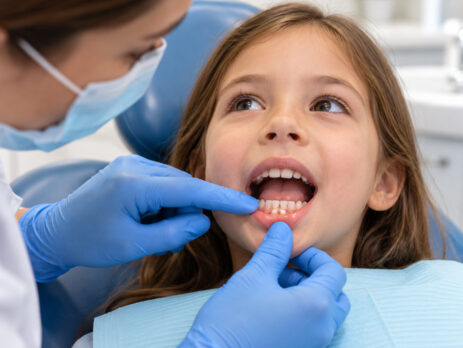
During the examination, the mobility of the primary tooth and the eruption direction of the permanent tooth are primarily evaluated. The amount of space in the jaw, the development of the opposing tooth, and occlusion relationships are also examined.
If deemed necessary, a radiographic examination can be performed to evaluate the roots and positions of the teeth. Routine X-rays are not required for every child.
If significant crowding or a problem related to jaw development is detected, a separate evaluation can be made regarding orthodontic treatment options.
If Not Intervened, Will Crowding Occur in Permanent Teeth?
Not every appearance of double row teeth results in permanent crowding. However, the primary tooth remaining in place for a long time and insufficient space in the jaw can contribute to irregular tooth positioning in some children.
Also, cleaning between two teeth that are close to each other can become difficult. This situation can increase plaque buildup and gum problems.
What is important is not just the appearance of the tooth, but whether its natural development continues in a healthy way.
How is Children’s Tooth Change Evaluated at Melsadent?
At Melsadent Oral and Dental Health Polyclinic, the development of children’s primary (milk) and permanent teeth is individually evaluated within the scope of pedodontics. The eruption sequence of the teeth, existing spaces, and the child’s oral health are considered together.
The aim at our clinic in Istanbul Tuzla is to support natural tooth change and determine the appropriate treatment approach when necessary. If you notice an unusual change in your child’s teeth, you can get information about an examination through Melsadent.
Frequently Asked Questions
Is it dangerous for a tooth to erupt from behind without the primary (milk) tooth falling out?
In most cases, it does not pose an immediate danger. However, if the primary (milk) tooth is not loose at all, if the permanent tooth is significantly mispositioned, or if there is pain, a dentist’s evaluation is necessary.
Will a permanent tooth erupting from behind correct itself?
Especially for lower front teeth, natural improvement in position can be observed after the primary (milk) tooth falls out. If there is not enough space in the jaw, further evaluation may be needed.
Can I extract my child’s non-loose primary (milk) tooth at home?
No. Forcibly extracting it can damage the gum, cause pain and bleeding. The need for extraction must be determined by a dentist.
Is it normal for a primary (milk) tooth not to be loose while the permanent tooth is erupting?
Sometimes the tooth may remain fixed because the root of the primary (milk) tooth has not sufficiently dissolved. Especially if the permanent tooth has advanced, it is recommended to investigate the cause with an examination.
Are braces needed for the appearance of two rows of teeth?
Not always necessary. The position may correct itself after the baby tooth falls out. The need for orthodontic treatment is determined by evaluating the placement of permanent teeth and jaw development.
Scientific Resources and Clinical Guides
The following resources can be utilized for assessments related to tooth replacement, eruption differences, and retention of primary teeth in children:
- American Academy of Pediatric Dentistry – Management of the Developing Dentition and Occlusion
- AAPD – Management Considerations for Pediatric Oral Surgery and Oral Pathology
- Australian Dental Journal – Eruption Disturbances in the Mixed Dentition
- PubMed Central – What to Spot and What Not to Miss: Key Anomalies During the Developing Dentition
Important: This content has been prepared for general informational purposes. Whether your child’s teeth need extraction, monitoring, or orthodontic evaluation can only be decided after a clinical examination.