What is Restorative Dental Treatment? Filling and Tooth Repair
What is Restorative Dental Treatment?
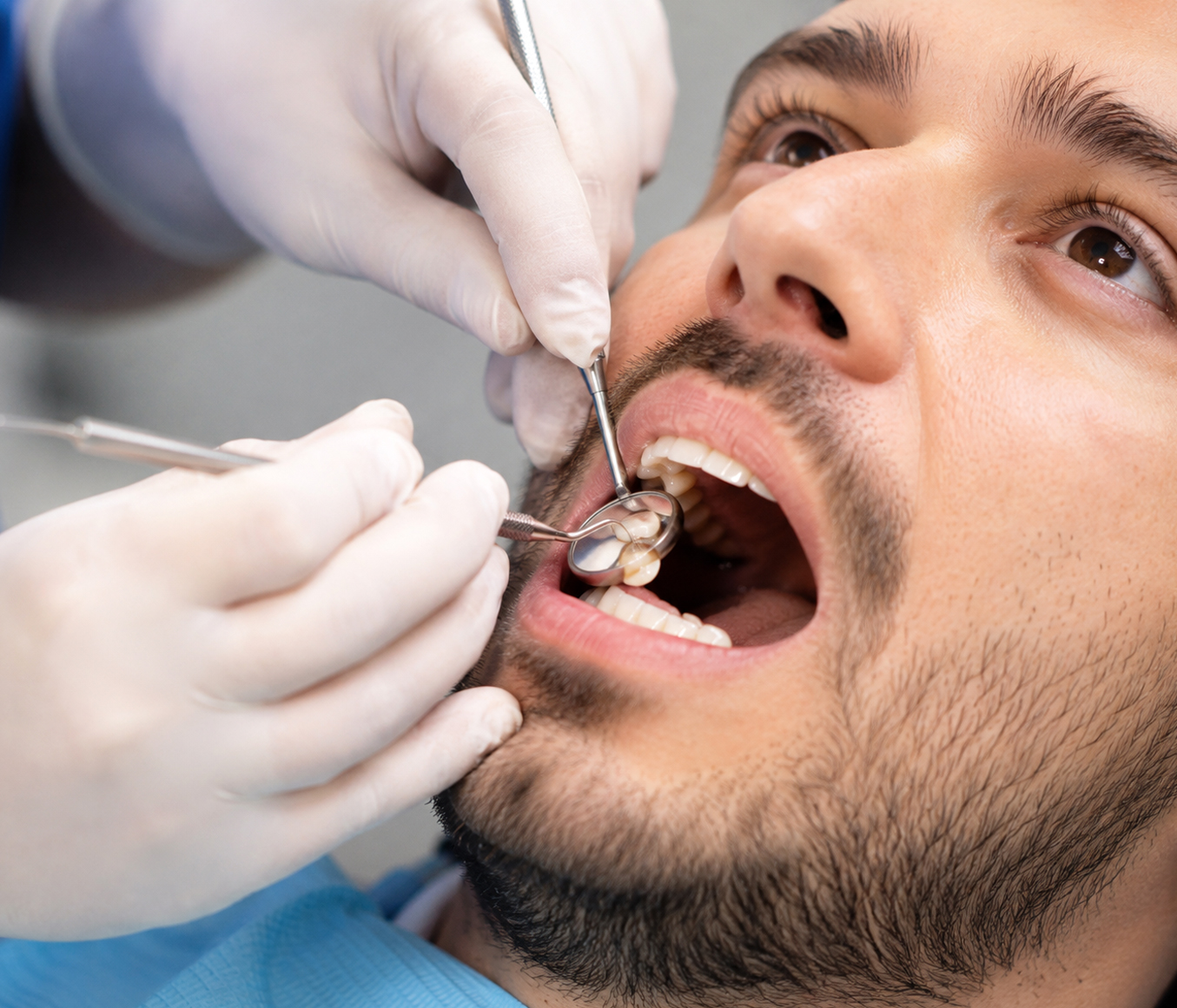
Restorative dental treatment is a field of dentistry that aims to repair lost tooth tissue, preserving it as much as possible, due to decay, fracture, wear, cracks, discoloration, or deterioration in previously performed restorations. The main goal of the treatment is not only to fill the cavity in the tooth. It aims to restore the tooth’s natural anatomy, chewing function, contact with adjacent teeth, and, whenever possible, its natural appearance.
One of the most important principles of modern restorative dentistry is to preserve sound tooth tissue as much as possible. Therefore, nowadays, instead of extensive grinding for every decayed or broken tooth, more conservative methods can be evaluated depending on the size of the problem and the remaining sound tooth tissue.
In Melsadent Oral and Dental Health Polyclinic’s approach to decayed and broken tooth repair and restorative dental treatment, the aim is to restore the function and aesthetics of the damaged tooth and to determine the appropriate restoration method after examination.
What Problems Does Restorative Dental Treatment Address?
Restorative dental treatment has a very wide range of application. The same treatment is not applied to every patient. The vitality of the tooth, the amount of lost tissue, the depth of the decay, teeth grinding habits, occlusal relationship, and aesthetic expectations can change the choice of treatment.
The main situations in which restorative treatment can be considered are:
- Treating tooth decay,
- Repairing small and medium-sized tooth fractures,
- Correcting edge fractures occurring in front teeth,
- Evaluating old fillings or those with compromised marginal integrity,
- Closing some small gaps between teeth with composite material,
- Correcting shape irregularities on the tooth surface,
- Reconstructing abraded tooth surfaces,
- Repairing tooth tissue loss due to trauma,
- Restoring abrasion and substance loss occurring in the cervical (neck) region,
- Reconstructing the superstructure of the tooth after root canal treatment,
- Aesthetic arrangement of specific teeth that pose problems in terms of color, shape, or symmetry.
However, in cases where tooth tissue loss is very advanced, a direct filling alone may not be sufficient. In such situations, different restoration options such as inlays, onlays, overlays, or crowns may need to be evaluated.
What is the Main Goal of Restorative Dental Treatment?
The most important aim of restorative treatment is to keep the patient’s own natural tooth healthy and functional in the mouth for as long as possible. The ability of a tooth to properly bear chewing forces is as important as its appearance.
Among the goals aimed for with successful restorative treatment are:
- Control of carious or damaged tissue,
- Preservation of sound tooth tissue,
- Restoration of the chewing function of the tooth,
- Creation of correct contact points between teeth,
- Reduction of food impaction,
- Elimination of the cause of sensitivity and similar complaints,
- Creation of a form as close as possible to the natural shape of the tooth,
- Achieving a natural-looking aesthetic result, especially in the anterior region
are among the objectives.
How is Restorative Dental Treatment Planned?
Treatment planning is not done by simply looking at the tooth. First, the patient’s complaints are listened to, and an intraoral examination is performed. If necessary, using X-ray images, the depth of the decay, the condition of existing fillings, the tissues around the tooth root, and the degree of relationship with the pulp are evaluated.
As stated in Melsadent’s 2026 dental filling guide, in restorative treatment planning, after the examination, the size of the decay or fracture is evaluated; then the appropriate material and type of restoration are determined.
Before restorative treatment, it is especially important to answer the following questions:
- Is the tooth vital?
- How deep is the decay?
- Is the remaining sound tooth tissue capable of supporting the restoration?
- Is there a crack or fracture in the tooth?
- Has root canal treatment been performed before?
- Is there a habit of teeth clenching or grinding?
- What is the occlusal relationship with the opposing teeth?
- Will a direct filling be sufficient?
- Is a more comprehensive restoration necessary?
Based on these evaluations, a personalized treatment plan is created.
What is a Composite Filling?
Composite fillings are among the most frequently used materials in restorative dentistry. These tooth-colored, resin-based materials can be used on both anterior and posterior teeth in suitable cases.
After the tooth tissue lost due to decay is cleaned and necessary surface preparations are made, the composite material is bonded to the tooth, shaped, and polymerized with special light curing units. Subsequently, the bite is checked, and surface polishing is performed.
One of the significant advantages of composite fillings is their ability to create a natural result, especially in visible areas, thanks to their tooth-colored appearance.
For more information about composite fillings and current applications, Melsadent’s composite aesthetic filling and bonding guide can be reviewed.
Is Bonding a Restorative Treatment?
Yes. Composite bonding can be considered one of the common applications of restorative and aesthetic dentistry in suitable cases. During bonding, tooth-colored composite material is applied directly to the tooth surface to adjust the tooth’s shape, length, or contours.
Bonding can be particularly considered for:
- Small fractures of anterior teeth,
- Limited spaces between teeth,
- Irregularities in the tooth edge,
- Certain shape deformities,
- Specific aesthetic asymmetries
can be considered.
Not every diastema or aesthetic problem is suitable for bonding. A direct decision for bonding should not be made without evaluating the position of the teeth, the occlusal relationship, and the size of the gap.
What is Inlay and Onlay Restoration?
In some cases where tooth substance loss is greater than a standard filling but a crown covering the entire tooth is not required, inlay or onlay restorations may be considered.
These are indirect restorations prepared outside the mouth or with the help of digital systems and then bonded to the tooth. While an inlay mostly restores the area between the cusps of the tooth, an onlay can also cover one or more cusps.
When deciding on the type of restoration, not only the size of the cavity but also the thickness of the remaining tooth structure and how chewing forces are distributed are taken into account.
Filling or Crown: Which is Better?
There is no single answer to this question that applies to everyone. Preserving as much sound tooth tissue as possible is one of the important principles of the modern restorative approach. Therefore, in a tooth with sufficient sound tissue that can be properly restored, direct or indirect conservative restoration options may be considered.
However, a more comprehensive restoration may be necessary in cases where a large part of the tooth is lost, there are severe cracks, or the remaining tissue is not sufficiently resistant to chewing forces.
To examine the fundamental differences between these two methods in more detail, you can access the Melsadent content titled Filling or Crown?.
Is it Possible to Preserve the Tooth Nerve in Deep Caries?
Not every deep cavity automatically requires root canal treatment. In current restorative dentistry, the condition of the dental pulp is evaluated as much as the depth of the caries.
The scientific consensus published by the International Caries Consensus Collaboration emphasizes the importance of biological and conservative approaches as much as possible in the management of carious tissue. The consensus states that it is not necessary to aggressively remove all affected dentin until hard tissue is reached in every case. You can access the academic publication via PubMed.
Especially in deep caries close to the pulp, the treatment decision should be made by evaluating the patient’s complaints, pulp tests, radiographic findings, and clinical examination together.
The position statement of the European Society of Endodontology regarding deep caries and pulp management also defines the preservation of pulp vitality in appropriate cases as one of the important goals of modern treatment philosophy. For the relevant scientific resource, you can review the European Society of Endodontology position statement.
What is the Difference Between Restorative Dental Treatment and Root Canal Treatment?
Restorative dental treatment and endodontics are related but distinct fields.
If the caries only involves the enamel and dentin tissues and the pulp is healthy, restorative treatment may often be sufficient. However, if there is infection or irreversible pulp damage, root canal treatment may become necessary.
In root canal treatment, the infected or damaged pulp tissue inside the tooth is removed, and the root canals are cleaned and filled. Subsequently, the upper part of the tooth needs to be rebuilt with an appropriate restoration.
To learn in which situations root canal treatment may be necessary, Melsadent’s root canal treatment (endodontics) page can be reviewed.
Can a Tooth with Root Canal Treatment Receive Restorative Treatment?
Yes. The completion of root canal treatment does not always mean that the tooth’s treatment is finished. For the tooth to function in the mouth, its lost coronal structure must be restored.
The restoration to be applied after root canal treatment may vary depending on the amount of remaining sound tooth tissue, whether the tooth is in the anterior or posterior region, chewing forces, and the risk of fracture.
While composite restorations may be sufficient in some cases, different indirect restoration options may be considered for teeth with greater substance loss.
Should an Old Filling Always Be Completely Replaced?
No. Replacing an old filling based solely on its age is not the correct approach. The marginal adaptation of the restoration, the presence of cracks or fractures, new decay formation under or around it, the patient’s complaints, and radiographic findings should be evaluated.
In some cases of limited defects, it may be possible to repair the restoration instead of completely removing it. This can prevent unnecessary loss of sound tooth tissue.
Systematic evaluations comparing the repair and complete replacement of restorations show that, in appropriate cases, repair can be a more conservative option. The scientific systematic review on this topic can be accessed via PubMed.
Are Digital Technologies Used in Restorative Dentistry?
Digital dentistry can provide significant advantages, especially during the planning and production of indirect restorations. Digital impressions of teeth can be taken with intraoral scanners, and in suitable cases, computer-aided design and manufacturing systems can be utilized.
Digital systems can offer an alternative to traditional impression methods and allow for a more detailed evaluation of restoration design.
For detailed information about the digital systems used at Melsadent, the digital dentistry page can be visited.
Is Restorative Dental Treatment Painful?
Restorative treatments are mostly performed under local anesthesia when necessary. Therefore, the aim is not to feel pain during the procedure.
While some superficial procedures may not require anesthesia, local anesthesia can be applied for deep cavities or sensitive teeth.
After treatment, short-term hot-cold sensitivity or a difference during chewing may be felt. However, if symptoms such as increasing pain, pain that wakes you up at night, constant throbbing, or swelling are present, a dental check-up is required.
How Long Does It Take to Get a Filling?
Treatment duration varies depending on the size of the restoration, the depth of the cavity, the number of surfaces restored, and the method used. A small composite restoration and a large restoration involving several surfaces are not completed in the same amount of time.
A significant portion of direct composite restorations can be completed in a single session. However, some indirect restorations, such as inlays, onlays, or those requiring a laboratory stage, may require multiple stages.
What Should Be Considered After Restorative Dental Treatment?
If local anesthesia has been applied, care should be taken not to bite the lips, cheeks, and tongue until the numbness completely wears off. This is especially important for child patients.
After restoration:
- The dentist’s specific recommendations should be followed,
- Teeth should be brushed regularly,
- Spaces between teeth should be cleaned using appropriate methods,
- Breaking excessively hard substances with teeth should be avoided,
- If there is teeth clenching or grinding, the dentist should be informed,
- If a filling feels high, a check-up appointment should be made,
- Regular dental check-ups should not be neglected.
How Long Does Restorative Dental Treatment Last?
It is not accurate to state the same number of years a filling or another restoration will last for everyone. The size of the restoration, the material used, the tooth’s position, the application technique, oral hygiene, decay risk, teeth clenching habits, and frequency of check-ups can affect the lifespan of the restoration.
Scientific studies evaluating the clinical longevity of direct restorations show that numerous factors related to the patient, dentist, and tooth, not just the material, influence success. One of the scientific evaluations examining the long-term results of composite restorations can be accessed via PubMed.
A comprehensive umbrella review on the clinical longevity of direct dental restorations published in 2026 also evaluates the performance of different restorative materials and reasons for failure based on high-level scientific evidence. The relevant academic publication can be accessed here.
Which Factors Affect the Lifespan of a Filling?
Factors that can affect the lifespan of a restoration may vary from person to person. The main factors are:
- The size of the restoration and the number of surfaces it covers,
- The amount of remaining sound tooth structure,
- Whether the tooth is in the anterior or posterior region,
- The intensity of chewing forces,
- Teeth grinding and clenching habits,
- Oral hygiene,
- The risk of developing new cavities,
- Dietary habits,
- The technically correct application of the restoration,
- Regular dental check-ups.
Therefore, before asking “which filling has the longest lifespan?”, it is necessary to evaluate which material is suitable for the relevant tooth and patient.
How Do I Know if a Filling Has Failed After Restorative Treatment?
A restoration merely falling out visibly does not always mean there’s a problem. Smaller symptoms may also require examination.
Dental evaluation is recommended in the following situations:
- A portion of the filling breaking,
- Dental floss constantly catching or shredding at the edge of the filling,
- New onset pain during chewing,
- Prolonged sensitivity to hot or cold,
- Discoloration around the filling,
- Food constantly getting stuck in the same area,
- Feeling a sharp edge on the tooth,
- Suspecting that the restoration is loose,
- Noticing a crack or fracture in the tooth.
These symptoms do not always mean that the filling needs to be completely replaced. It should first be examined.
Is Restorative Dental Treatment an Aesthetic Treatment?
The primary goal of restorative dental treatment is to restore dental health and function; however, thanks to the tooth-colored materials used today, aesthetics are also an important part of treatment planning.
Especially in anterior tooth restorations, simply choosing the right color is not enough. The tooth’s light-transmitting properties, surface texture, anatomical contours, marginal form, and harmony with adjacent teeth must also be considered.
Therefore, modern restorative dentistry adopts an approach that evaluates function and aesthetics together.
Is Restorative Treatment Not Required Before Tooth Decay Begins?
Yes. Not every initial enamel change necessarily means the tooth needs to be drilled and filled. Whether the decay is active, the condition of the enamel surface, and the depth of the lesion are evaluated.
In some early-stage lesions, improvement of oral hygiene, fluoride applications, dietary adjustments, or preventive methods may be considered.
Therefore, early diagnosis is important. More detailed information about approaches to reduce cavity formation can be found in Melsadent’s content on tooth decay prevention and preventive methods.
Is the Goal of Restorative Dental Treatment to Save the Tooth?
The fundamental approach is to preserve the natural tooth whenever possible. However, not every tooth can be saved with restorative methods. In cases such as a serious problem in the tooth’s root, the fracture extending far below the gum line or bone level, advanced periodontal support loss, or tissue loss to an extent that makes restoration impossible, different treatments may be necessary.
Therefore, it is not correct to make a definitive decision such as “this tooth can be filled” or “this tooth should be extracted” by looking at a photo seen on the internet or solely at symptoms.
The correct decision is made after a clinical examination and necessary imaging.
Who Can Undergo Restorative Dental Treatment?
Restorative dental treatments can be applied to a wide group of patients, from children to elderly adults. However, the material and method used may vary depending on the patient’s age, oral hygiene, caries risk, compliance with treatment, and the condition of the tooth.
Especially in patients with a high risk of decay, merely filling the existing cavity is not sufficient. The factors causing new cavities to form must also be identified. Otherwise, new decay may develop around a successfully performed restoration over time.
What Determines Restorative Dental Treatment Prices?
There is no single standard fee for restorative dental treatment. Factors influencing treatment cost may include the number of teeth to be restored, the extent of substance loss in the tooth, the type of restoration used, material selection, and additional treatment requirements.
The scope of treatment for a small single-surface composite restoration is not the same as that for an indirect restoration performed for a tooth with extensive substance loss.
Therefore, a clinical examination must first be performed for a definitive treatment plan and pricing.
How is Restorative Dental Treatment Evaluated at Melsadent?
At Melsadent Oral and Dental Health Polyclinic, for teeth requiring restorative treatment, the cause of the existing problem and the loss of tooth tissue are first evaluated. If necessary, the scope of the restoration can be planned using radiographic images and digital dentistry facilities.
The main goal is not only to close the visible gap; but to evaluate the tooth’s health, function, occlusal relationship, and aesthetic appearance together.
If you have a decayed or broken tooth, an early examination can help evaluate more conservative treatment options before further tooth tissue is lost.
You can create an appointment request from the Melsadent online appointment page for examination and treatment planning.
Frequently Asked Questions
What is restorative dental treatment?
Restorative dental treatment is a field of dentistry that aims to restore the function and aesthetics of teeth that have lost tooth tissue due to decay, fracture, wear, or different reasons.
Are fillings done in restorative dental treatment?
Yes. Composite fillings are among the most commonly applied methods of restorative dental treatment. However, a standard filling may not be suitable for every tooth.
Are restorative dental treatment and aesthetic dentistry the same thing?
Not exactly. The primary goal of restorative treatment is to restore the health and function of the tooth. However, in modern restorative applications, a natural appearance is also an important treatment objective.
Is restorative dental treatment painful?
When necessary, local anesthesia is applied to ensure that no pain is felt during the procedure. Short-term sensitivity may occur after treatment.
Is root canal treatment directly applied to a deeply decayed tooth?
No. The depth of the decay alone is not sufficient to decide on root canal treatment. The clinical condition of the pulp, the patient’s symptoms, and radiographic findings should be evaluated together.
Can an old filling be repaired without being replaced?
Repair may be possible for some limited fractures or margin problems. However, if there is decay under the restoration, extensive fracture, or another problem, more comprehensive treatment may be required.
What is the difference between bonding and filling?
Composite material can be used in both. While a filling mostly aims to repair decay or lost tooth structure, the term bonding is more frequently used for aesthetic shape modifications and the repair of small fractures.
Can one eat after restorative treatment?
The dentist’s recommendations may vary depending on the material used and the anesthesia status. If local anesthesia has been administered, it is generally safer not to chew until the numbness has completely worn off.
If my filling feels high, will it correct itself over time?
If a newly placed restoration feels significantly high during biting, it should be checked by a dentist. Continuous high contact can cause discomfort in the tooth or surrounding tissues.
Does a composite filling stain?
Composite materials may show discoloration over time due to factors such as dietary habits, smoking, surface wear, and oral hygiene. Whether polishing or replacement of the restoration is necessary is determined after an examination.
Does using dental floss cause a filling to fall out?
A healthy and properly done restoration should not fall out during normal dental floss use. If dental floss constantly gets caught, shreds, or if a problem is felt at the edge of the filling, it is beneficial to have the restoration checked.
Can a broken tooth be filled?
It depends on the size of the fracture and the remaining healthy tooth structure. While some small to medium-sized fractures can be repaired with composite restorations, large fractures may require different restoration options.
Can a root-treated tooth be filled?
Yes. However, the amount of healthy tooth structure remaining in a root-treated tooth is important. While direct restoration may be sufficient for some teeth, more comprehensive restoration may be required in some cases.
Is a filling or a crown healthier?
The healthiest option is the method that suits the tooth’s current condition and preserves as much natural tooth structure as possible while providing sufficient durability. Therefore, the decision should be made after examination.
Can restorative dental treatment be completed in a single session?
Many direct composite restorations can be completed in a single session. However, some restorations requiring inlays, onlays, or laboratory fabrication may require additional sessions.
Can a filled tooth decay again?
Yes. The filling material itself does not decay, but new decay can form in the natural tooth structure around the restoration. Therefore, regular oral hygiene and check-ups are important.
Is the purpose of restorative dental treatment solely aesthetic?
No. The primary purpose is the health and function of the tooth. However, aesthetic appearance is an important part of the treatment, especially thanks to modern tooth-colored materials.
Scientific Sources
- Innes NP, Frencken JE, Björndal L et al. Managing Carious Lesions: Consensus Recommendations on Terminology. PubMed.
- European Society of Endodontology. Management of Deep Caries and the Exposed Pulp. PubMed.
- Opdam NJM et al. Longevity of Composite Restorations Is Definitely Not Only About Materials. PubMed.
- Fernández E et al. Clinical Longevity of Direct Dental Restorations: An Umbrella Review of Systematic Reviews. PubMed.
- Mendes LT et al. Risk of Failure of Repaired Versus Replaced Defective Direct Restorations in Permanent Teeth: A Systematic Review and Meta-analysis. PubMed.
Important Note: This content has been prepared for general informational purposes. The choice of restorative treatment should be determined by a dentist, evaluating clinical examination, tooth vitality, remaining sound tooth tissue, radiographic findings, and patient-specific factors.