What Happens if an Impacted Tooth is Not Extracted? Is Waiting Harmful?
What Happens If an Impacted Tooth Is Not Extracted? Is Waiting for Years Harmful?
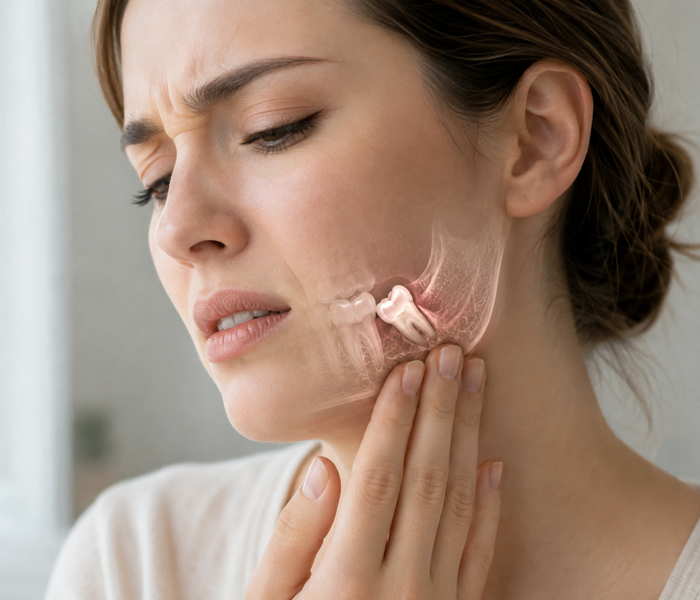
When an impacted tooth is seen on an X-ray, it usually brings the same question to patients’ minds: “What happens if an impacted tooth is not extracted?” Especially if the tooth doesn’t cause pain, there’s no swelling, and it doesn’t affect daily life, it might be thought that waiting for years wouldn’t be a problem. However, the decision regarding impacted teeth is not made solely based on the presence or absence of pain.
The short answer is this: Not every impacted tooth necessarily needs to be extracted; however, leaving an impacted tooth for years without any check-ups is also not the right approach. While some impacted teeth can remain for many years without causing any problems, others can lead to issues such as decay in the adjacent tooth, gum and bone loss, recurrent infection, root resorption, or cystic changes.
Therefore, the real question should not merely be “should it be extracted?” but rather, “Does extracting this impacted tooth or regularly monitoring it carry a lower risk?” The decision should be made by evaluating the tooth’s type, angle, position within the bone, its relationship with adjacent teeth, the patient’s age, oral hygiene, existing symptoms of illness, and surgical risks collectively.
For more detailed information about what impacted teeth are, why they occur, and basic treatment options, you can review our content titled What are Impacted Teeth and How are They Treated?
First, an Important Distinction: A Tooth That Doesn’t Hurt is Not the Same as a Healthy Tooth
One of the most common mistakes made regarding impacted teeth is to think, “It doesn’t hurt, so there’s no problem.” In dentistry, the concepts of “asymptomatic” and “disease-free” do not carry the same meaning.
An asymptomatic impacted tooth is a tooth where the person does not currently feel pain, swelling, or a noticeable complaint. However, on an X-ray, decay, bone loss, root resorption in the adjacent tooth, or an abnormal area around the tooth may be observed. This means that even if the patient feels nothing, changes in the surrounding tissues may have already begun.
A disease-free impacted tooth, on the other hand, is a tooth where no significant pathology is detected during clinical examination and necessary radiographic evaluation. This distinction is critically important when deciding whether to extract an impacted tooth.
Therefore, instead of just considering the question “does it hurt?”, the health of the tissues surrounding the tooth, and especially the adjacent second molar, should also be evaluated.
Can an Impacted Tooth Remain Problem-Free for Years?
Yes. Some impacted teeth that remain completely within the bone, show no signs of disease around them, and have a low probability of harming adjacent structures can remain problem-free for a long time. In fact, some individuals may never experience a significant problem caused by their impacted wisdom teeth throughout their lives.
However, the important word here is “follow-up.” Deciding not to extract an impacted tooth should not mean forgetting about it.
The American Association of Oral and Maxillofacial Surgeons (AAOMS) states that active clinical and radiographic follow-up is an option for third molars without disease or significant risk of disease. Similarly, a systematic review published by Cochrane reports that there is insufficient evidence to definitively show that routine extraction or retention of completely asymptomatic and disease-free impacted wisdom teeth is superior.
In other words, the approach that “all impacted teeth should be extracted” is just as much an overgeneralization as “an impacted tooth that doesn’t hurt should never be touched.”
What Problems Can Arise If an Impacted Tooth is Not Extracted?
The risk posed by an impacted tooth varies, especially according to the tooth’s position. Lower wisdom teeth that are partially erupted, tilted forward, or in contact with the adjacent second molar should be evaluated more carefully for certain problems.
The main problems that can be observed in impacted teeth not followed up for a long time are listed below.
- Formation of decay in the adjacent second molar
- Development of decay around the impacted tooth
- Gum infection called pericoronitis
- Periodontal pocket and bone loss around the adjacent tooth
- Resorption in the root of the adjacent tooth
- Cystic changes around the tooth
- Recurrent pain, swelling, and difficulty opening the mouth
- Bad breath and bad taste
- Sensitivity during chewing
- Rarely, development of larger jawbone lesions
1. The Adjacent Healthy Tooth May Decay
One of the most important long-term problems of an impacted wisdom tooth is its potential to affect the second molar tooth immediately in front of it.
Especially in the mandible, an impacted wisdom tooth tilted forward, i.e., in a mesioangular position, can come into contact with the distal surface of the second molar tooth. Cleaning this area with a toothbrush and dental floss can be quite difficult. Over time, plaque accumulation can lead to the development of decay on the distal surface of the second molar tooth.
In a systematic review and meta-analysis published in 2025, caries on the distal surfaces of second molars adjacent to impacted mandibular third molars were investigated. The combined data from the studies reported that the mesioangular impaction position, in particular, was associated with a higher risk of caries.
The critical point here is this: While the impacted wisdom tooth may not cause pain, the fully functional second molar in front of it can be damaged. Therefore, during follow-up, not only the impacted tooth but also the adjacent tooth should be carefully examined.
2. Gum and Bone Problems Can Progress Silently
Areas around impacted or partially erupted third molars that are difficult to clean can create a predisposition for periodontal problems. Especially the formation of a deep periodontal pocket on the distal side of the second molar can lead to a reduction in bone support in the long term.
A systematic review and meta-analysis from 2022 evaluated the relationship between the presence of third molars and periodontal pathology in adjacent second molars and showed that the mandibular region, in particular, should be carefully monitored.
Since there may not be significant pain in the early stages of gum disease, it is not correct to make a decision based solely on the patient’s complaint.
3. Infection Can Develop in a Partially Impacted Wisdom Tooth
If a part of the tooth has erupted into the mouth but another part remains under the gum, a pocket that is difficult to clean may form on or around the tooth. Food debris and bacteria can accumulate in this area.
The inflammation of the soft tissue over the tooth is called pericoronitis. During pericoronitis, gum pain, swelling, bad taste, bad breath, sensitivity while chewing, and in some cases, difficulty opening the mouth may be observed.
A first and mild episode of pericoronitis does not always automatically mean that the tooth will be extracted. However, recurrent infections are an important finding for evaluating the decision of surgical extraction.
In the guidelines for impacted wisdom tooth extraction published by the UK National Institute for Health and Care Excellence, recurrent pericoronitis episodes are also taken into consideration when evaluating the extraction indication.
4. Resorption Can Occur in the Root of an Adjacent Tooth
An impacted tooth, depending on its position, may be in close contact with the root of an adjacent tooth. In some patients, this contact can lead to external root resorption on the root surface of the second molar.
An important characteristic of root resorption is that it may not cause pain initially. The problem can only be detected during a radiographic examination. In advanced cases, the prognosis of the adjacent tooth may also be affected.
Therefore, especially when close contact is observed between an impacted tooth and the second molar in a panoramic X-ray, a more detailed evaluation may be necessary.
5. Can a Cyst Form Around an Impacted Tooth?
A dental follicle is normally found around the crown of an impacted tooth. In rare cases, cystic or other pathological changes may develop in these tissues.
Scientific studies examining odontogenic cysts and tumors associated with impacted third molars show that these complications are possible. However, this information should not be interpreted to mean that every impacted tooth will form a cyst in the future.
The risk is individual, and a detailed evaluation is necessary if suspicious changes are observed, such as an enlargement of the area around the tooth’s crown on a radiograph.
If an Impacted Tooth is Not Extracted, Does it Push the Front Teeth Forward?
It is a common belief in society that wisdom teeth push the front teeth and therefore must be extracted. However, scientific evidence is not as conclusive on this matter as one might think.
The Cochrane review states that there is no strong evidence to suggest that the extraction of asymptomatic and disease-free impacted wisdom teeth significantly prevents late-onset crowding in the dental arch.
Therefore, it is not correct to state that every impacted wisdom tooth should be extracted solely on the belief that it will push the front teeth forward in the future. Orthodontic crowding is a multifactorial condition and requires individual assessment.
If an Impacted Tooth is Left for Years, Does its Extraction Become More Difficult?
The answer to this question is yes for some patients. The difficulty of the surgical procedure is not solely dependent on age; the shape of the roots, the depth of the tooth within the bone, its proximity to the nerve canal, bone structure, and accompanying diseases also play a significant role.
However, as age progresses, changes in bone characteristics and healing capacity may occur. Furthermore, if periodontal or other pathologies have developed around the tooth in later years, the procedure may become more complex compared to the initial situation.
In AAOMS’s scientific assessment on third molar management, it is also stated that surgery can become more difficult with age and that the decision between extraction and active follow-up should be evaluated during young adulthood.
However, this does not mean that a wisdom tooth cannot be extracted after a certain age. Each patient should be evaluated according to their own clinical and radiographic findings.
If an Impacted Tooth is Close to a Nerve, Can it Be Left Without Extraction?
The roots of impacted wisdom teeth in the lower jaw may be located close to the inferior alveolar nerve canal in some patients. If a close relationship is suspected on a panoramic X-ray, the tooth’s relationship with the nerve can be evaluated in more detail with three-dimensional imaging in necessary cases.
Proximity to the nerve alone does not mean ‘definitely cannot be extracted’ or ‘definitely should be waited’. The risk of disease caused by the tooth is compared with the risk of surgical complications.
In some selected cases, different surgical approaches other than classic full extraction may also be considered. The suitability for which patient is decided after clinical and radiographic examination.
For detailed information about imaging methods at Melsadent, you can visit our Panoramic Dental X-ray and 3D Tomography page.
Is Panoramic X-ray Sufficient to Evaluate an Impacted Tooth?
In the initial evaluation of impacted teeth, panoramic X-ray is one of the commonly used imaging methods. A panoramic image provides important information about the tooth’s position, eruption direction, roots, relationship with adjacent teeth, and surrounding bone structure.
However, in some cases, a two-dimensional panoramic image may not be sufficient. Especially when the lower wisdom tooth appears very close to the nerve canal, there is suspicion of root resorption in an adjacent tooth, or when a three-dimensional anatomical relationship could alter the treatment plan, dental tomography, also known as CBCT, may come into question.
Tomography is not routinely necessary for every impacted tooth. The imaging method should be chosen according to the patient’s needs and the clinical question.
Which Impacted Teeth Are More Strongly Considered for Extraction?
Although the conditions supporting the extraction of an impacted tooth vary from patient to patient, the presence of untreatable decay, recurrent infection, abscess, damage to an adjacent tooth, root resorption, periodontal disease, cystic changes, or another pathology can strengthen the decision for surgical treatment.
A systematic review published in 2021 evaluating the indications for extraction of impacted third molars reports that extraction is supported for disease-associated third molars; whereas an automatic extraction approach is not supported in cases where there are no signs of infection or other disease.
Therefore, the decision should not be made solely by stating “there is an impacted tooth” on the X-ray, but by evaluating the current and future risks posed by the tooth.
Which Impacted Teeth Can Be Followed?
In some impacted teeth that show no signs of disease during examination and imaging, do not harm adjacent structures, and where the expected benefit of surgical treatment is low, active monitoring may be preferred.
However, “monitoring” is not a passive waiting. Clinical examinations should be performed at intervals determined by the dentist, and if necessary, the previous condition should be compared with new radiographic images.
During controls, the eruption status of the tooth, surrounding gingiva, distal surface of the second molar, periodontal pocket depth, caries formation, and radiographic changes are evaluated.
Are Impacted Canine Teeth and Impacted Wisdom Teeth Evaluated Similarly?
No. The term “impacted tooth” does not only cover wisdom teeth. Different permanent teeth, especially canine teeth, can also remain impacted.
Especially with impacted canine teeth, the goal is not always to extract the tooth. If the patient’s age, tooth position, and orthodontic conditions are suitable, surgical exposure of the tooth and guiding it to its correct position in the mouth with orthodontic treatment may be considered.
Therefore, information read online about impacted wisdom teeth should not be directly applied to all impacted teeth.
Is a Fully Impacted or Partially Impacted Wisdom Tooth More Risky?
Risk cannot be determined solely by whether it is “fully” or “partially” impacted. However, in partially erupted wisdom teeth, due to the connection with the oral environment, cleaning the area can be difficult, and the development of infections like pericoronitis can be facilitated.
Even in teeth completely within the bone, where there is no direct connection with the oral environment, evaluation is still necessary for contact with an adjacent tooth, root resorption, or radiographic changes around the tooth.
Therefore, not only whether the tooth is visible or not, but also its angle, depth, and anatomical relationships are important.
Is It Harmful to Wait 5 or 10 Years for an Impacted Tooth?
There is no rule like “5 years is safe” or “it’s dangerous after 10 years” by giving a specific number of years. The behavior of impacted teeth can vary from person to person.
While an impacted tooth might remain unchanged for a decade, another patient might develop decay or a periodontal problem in an adjacent tooth in a shorter period. Therefore, what matters more than the duration is the current status of the tooth and its changes over time.
Waiting for years can only truly be considered “monitoring” if necessary check-ups are performed. Not having any panoramic evaluation for a decade is not the same as being under regular clinical check-ups for a decade.
Is It Always Better to Extract an Impacted Tooth Early?
Although surgical procedures may have some advantages at younger ages, the “earlier the better” approach is not correct for every patient.
The Cochrane review states that there is insufficient high-quality evidence to definitively demonstrate the long-term benefit of routine prophylactic extraction of asymptomatic and completely disease-free impacted wisdom teeth.
The NICE guideline also does not recommend routine prophylactic extraction of asymptomatic impacted third molars.
Conversely, unnecessarily long waiting times for teeth with existing pathology or those deemed to be at high risk of developing pathology in the future can lead to adjacent teeth also being affected.
The most appropriate approach is to avoid both unnecessary extraction and unnecessary waiting.
How is Impacted Tooth Extraction Performed?
If the tooth is fully or partially within the bone, a surgical approach may be necessary, differing from a classic simple tooth extraction. The method of the procedure varies depending on the tooth’s position and anatomical characteristics.
For detailed information about the surgical treatment process of impacted and wisdom teeth, you can visit our page on Surgical Extraction of Impacted and Wisdom Teeth.
Patients who want to learn about different surgical approaches can also check out our content on Wisdom Tooth Extraction with Microsurgery.
When Should a Dentist Be Consulted Without Delay for an Impacted Tooth?
When symptoms such as new or increasing pain in the impacted tooth area, gum swelling, facial swelling, bad taste, discharge of pus, significant difficulty opening the mouth, or fever appear, a check-up should not be delayed.
Especially, the development of rapidly progressing facial-neck swelling, difficulty swallowing, or breathing problems may require urgent evaluation.
Furthermore, even if there are no complaints, if you have previously been told “you have an impacted tooth” and no check-up has been done for a long time, an up-to-date clinical evaluation may be beneficial.
Extraction or Follow-up for an Impacted Tooth? How is the Decision Made?
The correct decision in impacted tooth management does not rely on a single factor. In the evaluation performed by the dentist or relevant surgical specialty, the tooth’s angle, depth, eruption potential, relationship with the second molar, proximity to the nerve canal, surrounding tissues, oral hygiene, and the patient’s age are considered together.
The general approach can be summarized as follows: If there is an existing disease, the need for treatment increases; if there is no disease but a high risk of developing problems in the future, preventive surgical options can be considered; if there is no disease and no significant risk, regular follow-up can be considered.
Therefore, whether another person’s impacted wisdom tooth has been extracted or not does not determine the correct treatment for you.
Instead of Forgetting an Impacted Tooth for Years, Actively Follow Up
“My impacted tooth doesn’t hurt, so I don’t need to do anything” approach, it is safer to know the current condition of the tooth. Because while some impacted teeth cause no problems, others may start to damage the surrounding second molar or bone.
Especially for impacted wisdom teeth that have not been checked for many years, a current panoramic evaluation can help compare with previous images and detect silently developing problems early.
At Melsadent Oral and Dental Health Polyclinic, patient-specific treatment planning can be done by utilizing clinical examination and necessary radiographic imaging methods in the evaluation of impacted teeth.
Frequently Asked Questions
Will an impacted tooth definitely cause problems if not extracted?
No. Some impacted teeth may not cause problems for many years, or even throughout life. However, it is not possible to understand which tooth will cause problems simply by checking for pain. Regular clinical and, if necessary, radiographic follow-up is important.
My impacted wisdom tooth doesn’t hurt, should it still be extracted?
Absence of pain alone is not sufficient to decide on extraction or follow-up. It should be evaluated whether there is decay, periodontal problem, root resorption, cystic change, or another risk in the neighboring tooth.
Is it harmful to leave an impacted tooth for 10 years?
It is not possible to say that a specific period, such as 10 years, is automatically harmful or safe. What is important is whether the tooth has been monitored during this period and whether changes have developed in the surrounding tissues.
Can an impacted wisdom tooth cause decay in the adjacent healthy tooth?
Yes. Especially forward-tilted lower wisdom teeth can make it difficult to clean the posterior surface of the second molar tooth and increase the risk of decay developing in this area.
Does an impacted tooth cause root resorption?
Impacted teeth in certain positions may be associated with external root resorption in the root of an adjacent tooth. This condition is not observed in every patient and is often evaluated by radiographic examination.
Does an impacted tooth cause a cyst?
It is possible for cystic changes to develop around impacted teeth, but not every impacted tooth forms a cyst. If suspicious changes are observed around the tooth on an X-ray, a detailed examination is required.
Can an impacted tooth cause bad breath?
Especially around a partially erupted wisdom tooth, plaque and food accumulation, gum inflammation, and infection can contribute to bad breath or a bad taste.
Does an impacted tooth push the front teeth?
There is no strong scientific evidence that wisdom teeth alone cause anterior tooth crowding and that extraction definitively prevents it. Crowding should be evaluated multifactorially.
Is a fully impacted wisdom tooth or a partially impacted tooth more dangerous?
This distinction alone is not sufficient. While the risk of infection may increase with partially impacted teeth, fully impacted teeth within the bone can also damage adjacent structures depending on their position. Radiographic position is important.
Is a panoramic X-ray sufficient for an impacted tooth?
In most cases, a panoramic X-ray provides important information during the initial assessment. When a more precise evaluation of the relationship with the nerve canal or other anatomical details is required, 3D dental tomography may be considered.
If an impacted wisdom tooth is close to a nerve, should it always be left alone?
No. Proximity to the nerve is an important factor in surgical planning but does not solely determine the treatment. The risk of disease caused by the tooth and the surgical risk are evaluated together.
At what age should an impacted tooth be extracted?
There is no single ideal age applicable to everyone. The tooth’s position, root development, disease risk, and the patient’s general condition should be evaluated. Since the difficulty of some surgical procedures may increase with age, it is beneficial to have an early assessment rather than waiting for a long time without control.
Should every impacted canine tooth be extracted?
No. In appropriate cases of impacted canine teeth, surgical exposure and orthodontic extrusion treatments can be applied. Therefore, impacted canine teeth should not be evaluated in the same way as wisdom teeth.
Will an impacted tooth erupt on its own?
The probability of the tooth erupting depends on the patient’s age, the tooth’s angle, the available space in the jaw, and the eruption path. Some impacted teeth in a completely unsuitable position are not expected to naturally move into a normal position.
Is it safer to extract or keep an impacted tooth?
There is no one-size-fits-all answer to this question. Extraction may be more advantageous if there is disease or high risk. In some teeth where there is no disease and no significant risk, regular clinical and radiographic follow-up may be preferred.
Not Extracting an Impacted Tooth is Not the Risk, Leaving it Uncontrolled Is
The answer to the question What happens if an impacted tooth is not extracted? varies according to the tooth’s position and the condition of the surrounding tissues. Some impacted teeth can remain problem-free for years. Others, without causing any pain, can contribute to the development of problems such as decay, periodontal bone loss, or root resorption in the adjacent second molar.
Therefore, keeping an impacted tooth for years is not wrong in itself; it is not correct to wait for years without ever having it checked. Through clinical examination and necessary radiographic evaluations, the current status of the tooth, its changes over time, and the benefits of extraction along with surgical risks can be assessed together.
If you know you have an impacted or partially impacted tooth but haven’t had it checked for a long time, getting a current dental evaluation before deciding on extraction will be the most appropriate approach.