Tuzla Seamless Implant | Implant with Melsadent Navigation
Tuzla Seamless Implant: Melsadent’s Navigation Implant Approach
When you are thinking of having an implant instead of a missing tooth, your patients only ask “How long will the implant last?” not the question; It is quite natural for him to wonder how the procedure will be done, whether the gingiva will be cut, whether stitches are needed, how the healing process will progress and how the implant is positioned correctly. Today, with the development of digital dentistry technologies, these questions are at the center. Implant with Navigation and Seamless implant applications are available.
Seamless Implant with Tuzla In terms of the patients who conducted the research, the prominent point in the approach of MELSADENT Oral and Dental Health Polyclinic is that the implant is not seen as an application evaluated only during the operation; The use of three-dimensional imaging and digital planning processes before treatment.
The aim of navigated implant surgery is to evaluate the area where the implant will be placed in detail before the operation and to transfer the planned implant position to the surgical application in a controlled manner in cases where possible. Thus, the angle, depth and relationship of the implant with the surrounding anatomical structures can be analyzed before the procedure.
Melsadent’s Seamless Navigation Implant As emphasized on the page, it is aimed to apply a more controlled implant by using 3D digital planning and surgical guides in the treatment.
Briefly: What is a seamless implant?
Seamless implant is a minimally invasive implant approach that aims to prepare the implant slot without creating a large gingival incision in the area where the implant will be placed in suitable patients and without completely removing the gingival tissue as in classical surgery.
This method can also be found from time to time with different names such as “interrupted implant”, “flapless implant”, “closed implant”, “guided implant” or “navigated implant”. However, it is important to know that these concepts do not mean exactly the same.
Implant with NavigationIt basically refers to the pre-planning of the implant using digital data and the transfer of this plan to the surgical application.. Seamless implant defines the surgical method of entry. While navigated implant surgery can be performed without sustenance in a suitable case, some patients may need to open the gingiva due to clinical necessity, although digital navigation is used in some patients.
For this reason, the statements such as “Navigational implants are definitely made without stitches” or “Seamless implants can be applied to everyone” are not correct.
What is Melsadent’s navigational implant approach based on?
On the website of Melsadent Oral and Dental Health Polyclinic, the basis of navigational implant treatment is the use of detailed examination, three-dimensional imaging, digital planning and surgical guide.
The important difference of this approach is that the position of the implant is tried to be determined as much as possible before the operation starts.
In traditional implant surgery, the physician determines the position of the implant by using clinical evaluation, radiological images and surgical field of vision. In computer-aided systems, the digital planning layer is added to this evaluation.
For more information about the digital part of the treatment Melsadent Digital Dentistry page can also be viewed.
The purpose of the navigational implant approach is not to replace the doctor’s experience with the computer. Digital systems are tools that help the physician in the planning and implementation phase. Final treatment decision; The patient’s bone structure, gum health, anatomical features, general health status and prosthetic restoration are evaluated and given by the physician.
The first stage in the treatment of seamless implants with Tuzla: Detailed examination
A successful implant treatment is not just about placing the implant in the bone. The starting point of treatment is the correct diagnosis and correct case selection.
During the implant evaluation in Melsadent, the missing tooth area, the condition of the existing teeth, the closing relationships, the gingival health and the general structure of the jawbone are evaluated.
The patient’s past health history is also important. Some uncontrolled systemic diseases, some drugs used, active periodontal infections, intense smoking, or inadequate oral hygiene may affect the planning of implant therapy.
For this reason, on the internet, “Is a seamless implant suitable for me?” It is not possible to give a definite answer to the question. Determination of conformity should be carried out after clinical examination and necessary radiological evaluations.
Patients who want to learn more about the general principles of implant treatment MELSADENT IMPLANT TREATMENT can view the page.
Why is 3D imaging important in seamless implant?
One of the most important stages of navigated implant treatment is the three-dimensional evaluation of the jawbone.
In the area where the implant will be placed, not only the height of the bone, but also the location of the anatomical structures are important. The nerve canal in the lower jaw, the maxillary sinus in the upper jaw, the roots of the neighboring teeth and the anatomical boundaries of the bone are structures that should be taken into account in planning.
Three-dimensional images help the physician to examine the implant area from different angles.
Thus, the following parameters can be evaluated prior to treatment:
- Height of the jawbone
- bone width
- Available bone volume for implant
- Roots of neighboring teeth
- Position of the nerve canal
- Relationship between the maxillary sinus and the implant site
- Implant diameter and length that can be planned
- Possible entry point of the implant
- The estimated angle and depth of the implant
The main purpose here is not just to place the implant inside the bone. It is also important to plan the implant in a position compatible with the crown or bridge it will carry in the future.
What does Digital Mouth Scan Do in Navigation Implant Planning?
In modern implant planning, only imaging of the bone may not be enough. Digital recording of teeth, gums and existing structures in the mouth is also one of the important parts of planning.
Digital recordings obtained with oral scanners can be evaluated together with three-dimensional images of the jawbone.
In this way, the physician only asks, “Where is the place for implants in the bone?” not only to the question, but also to the question “Where is the most suitable position for the tooth that will come on the implant?” can also seek an answer to the question.
This approach Prosthetic-focused implant planning important for the Because in the long run, it is aimed not only to integrate the implant with the bone, but also to be functional, cleanable and aesthetically suitable for the restoration to be made on it.
How is digital planning done in a navigational implant?
After obtaining three-dimensional radiological images and necessary digital mouth records, the planning of the implant in the virtual environment can be started.
During planning, the implant;
- entry point,
- angle,
- diameter,
- length,
- depth,
- relationship with neighboring anatomical structures,
- relationship with the prosthesis to be made on
can be evaluated.
One of the important advantages of computer-aided planning is that possible options can be evaluated before the operation.
This does not mean that no changes can be made during surgery. The actual clinical conditions of the patient are always priority and the physician can change the plan when necessary.
What is a surgical guide?
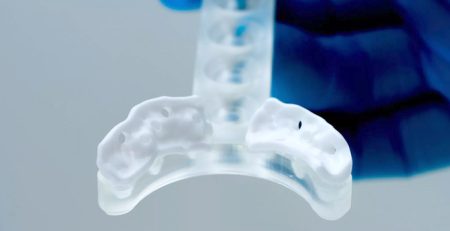
One of the important tools used in the treatment of seamless navigation implants surgical guide or also known as surgical guidestop.
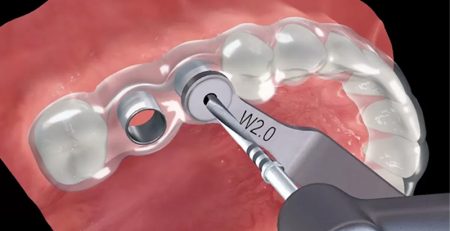
The surgical guide can be specially designed for the patient to help the application of the implant plan created in the digital environment in the mouth.
Routing zones on the guide help to prepare the implant slot in the planned direction.
To put it simply, digital planning is one of the tools that helps to follow this route in the mouth while creating a “route” while the surgical guide.
However, using surgical guides does not mean zero errors. Scientific studies show that certain amounts of deviation may occur between digitally planned and actual implant locations. For this reason, experienced clinical evaluation and maintaining anatomical safety distances continue to be important.
How to place a seamless implant?
When the patient is found suitable for a seamless implant, the surgical procedure can be performed through a more limited inlet of soft tissue compared to conventional open surgery.
By making a wide incision, a controlled entry area can be prepared in the area where the implant will be placed instead of removing the gingiva.
If the surgical guide is used, the preparation of the implant slot can be directed according to the position determined in digital planning.
Then the implant is placed in the jawbone.
In appropriate cases, sutures may not be required as there is no large surgical incision. This is where the expression “seamless implant” comes from.
However, if there is a bone increase, advanced surgical procedure or a situation that requires direct vision in the implant area, the classical surgical approach may be preferred.
About Melsadent’s approach to surgical treatments Oral, dental and maxillofacial surgery information can be obtained from the page.
What is the difference between a seamless implant and a classic implant?
| Evaluation | Seamless / Navigated Implant | Classic implant surgery |
|---|---|---|
| Planning | 3D digital planning and surgical guide in appropriate cases can be used. | It is planned on the basis of radiological and clinical evaluation. |
| Gum | In suitable cases, it can be applied without wide incisions. | Bone can be seen directly by removing the gingiva. |
| Stitch | may not be required in appropriate cases. | It may be required according to the surgical procedure. |
| surgical vision | The bone is evaluated through the digital plan and guide. | The bone surface can be seen directly. |
| soft tissue trauma | Flapless cases may be more limited. | Depending on the surgical method, it may be wider. |
| Relevance | It cannot be applied to every patient. | It can be used in a wide variety of cases. |
The important thing here is not to think that one of the methods is “better” than the other in any case. The best method is the one that is suitable for the clinical condition of the patient.
What are the advantages of a seamless implant?
When the right case is selected, there may be some important advantages of navigation and flapless implant surgery.
- More limited soft tissue intervention
- Prevention of large gingival incisions
- Eliminate the need for sewing
- Analyzing the implant position in the digital environment before the operation
- More controlled planning of implant angle and depth
- Enables prosthetic planning
- Helpful patients to help reduce post-operative discomfort
- To progress more comfortably in the process of returning to daily life
In the scientific literature, there are studies showing that flapless and computer-assisted implant surgery may provide advantages in some patient groups in terms of reducing post-operative pain and surgical time.
However, it cannot be said that the same result will be obtained in every patient.
Is the Implant with Navigation More Sensitive?
One of the main objectives of computer-aided implant surgery is to transfer the planned implant position into the mouth as accurately as possible.
Systematic reviews published on this subject show that computer-aided static and dynamic implant surgery can provide successful results in controlling the implant position.
For example, in a comprehensive systematic review and meta-analysis examining the accuracy of computer-assisted implant surgery, deviations in the entry point, apical region and angular position of implants were evaluated; It has been reported that the method can provide acceptable accuracy in many clinical situations.
However, the work is also Even if the surgical guide is used, there may be a deviation between the planned and actual implant position. and emphasizes that safety distance should be maintained in regions close to anatomical structures.
Scientific study:
A Systematic Review and Meta-Analysis
Is there a difference between a computer aided implant and a free hand implant?
In current studies comparing computer-aided implant surgery and traditional free-hand implant placement, there are findings that digital guided methods can provide higher accuracy in transferring the implant to the planned position.
In the systematic review and meta-analysis published in 2024, static, dynamic and robot-assisted computerized implant systems were evaluated and it was stated that computer-aided methods provide clinically usable accuracy in three-dimensional implant positioning.
Relevant academic study:
Accuracy of Implant Placement with Computer-Aided Static, Dynamic, And Robot-Assisted Surgery: A Systematic Review and Meta-Analysis
This does not mean that the physician experience has lost its importance. The advantage of digital technology is that it can support experienced clinical evaluation with a more detailed planning system.
Is the pain less after a seamless implant?
In implant treatment, the perception of pain may vary from patient to patient. Many factors such as the number of implants applied, the scope of the operation, the bone structure, additional surgical procedures and individual pain threshold affect postoperative comfort.
For this reason, it is not correct to use a definite statement such as “seamless implant is completely painless”.
However, in minimally invasive cases where a large gingival flex is not removed, the intervention to soft tissues may be more limited.
In a systematic review and meta-analysis evaluating flapless fully-guided implant surgery, some advantages have been reported in terms of postoperative pain and surgical duration in appropriate cases.
Academic Study:
Minimal Invasiveness at Dental Implant Placement: A Systematic Review
Does a seamless implant heal faster?
A more limited effect of gingival tissue may contribute to early recovery comfort in some patients.
However, “healing” in implant treatment is two different processes.
The first is the healing of the gingival and surgical site.
The second is the biological integration of the implant with the jawbone, that is, the osseointegration process.
The application of a seamless implant does not eliminate the biological process required for the implant to integrate with the bone.
For this reason, the fact that the patient feels well within a few days does not mean that permanent teeth can be made on the implant immediately.
When the superstructure will be prepared depends on many factors such as the primary stability of the implant, the application area, the bone structure, the number of implants and the treatment plan.
Does the Seamless Implant mean the same day to have teeth attached?
No.
Seamless implant Indicates how surgery is performed.
same day tooth or Immediate Loading on the other hand, it is about when to place prosthetic restoration on the implant under temporary or certain conditions.
Even if an implant is placed seamlessly, the same day may not be suitable for loading.
Similarly, an implant placed with classical surgery may be included in the loading protocol early or immediately if appropriate clinical conditions are available.
Therefore, the two concepts should be evaluated separately from each other.
Who can be suitable for a seamless implant with salt?
Eligibility for seamless navigation implant treatment can only be determined after examination and imaging.
In general;
- With sufficient bone volume in the implant area,
- Anatomical structures can be digitally evaluated,
- No active and uncontrolled infection
- suitable gingival tissues,
- No advanced bone increase
- General health status suitable for implant surgery
Patients can be evaluated in terms of flapless and navigational methods.
However, having any of these criteria alone does not mean eligibility for treatment.
Whose Seamless Implant may not be suitable for?
It is not correct to apply the seamless implant as the standard method for everyone.
For example, if there is serious bone loss in the area where the implant will be placed, direct vision of the bone tissue and additional surgical procedures may be required.
Classical surgery or a different treatment approach is preferable in the following cases:
- Advanced bone failure
- Bone graft requirement
- Sinus upgrade process requirement
- Active infection
- Complex anatomical structure
- Soft texture editing requirement
- Clinical conditions that require direct vision of the implant site
- Mouth opening or anatomical limitations that may complicate the use of digital guides
Therefore, the aim of the evaluation to be made in MELSADENT is not to apply a seamless implant to the patient, but to determine the most suitable implant protocol for the needs of the patient.
If the bone is insufficient, can I implant with navigation?
Bone volume is one of the main factors in implant treatment.
Navigation technology can help a more detailed evaluation of the existing bone, but it does not form the non-existent bone.
In some cases, the existing bone volume may be sufficient for the implant, while in some patients, bone graft or different advanced surgical applications may be required.
Therefore, the “bone graft is never needed thanks to a seamless implant” approach is not scientifically correct.
Necessary surgical options should be evaluated specifically for the patient.
Can a seamless implant be used in a single tooth deficiency?
If suitable bone and gingival conditions are available, implantation with navigation can be done in case of a single tooth deficiency.
The angle of the implant and its relationship with the restoration are especially important, especially in the regions where there are neighboring teeth.
Computer-aided methods can help digitally pre-plan the implant.
It has been reported that static and dynamic computer-assisted implant surgery in systematic review and meta-analysis, published in 2025 and examining immediate implant applications for a single tooth, may show a lower deviation in some positioning criteria compared to free hand practice. The authors of the study also underlined that the results should be interpreted carefully due to the heterogeneity among the studies.
Academic Study:
Accuracy of static and dynamic computer-aided implant surgery for Immediate Implant placement: a systematic review and meta-analysis
Can a navigation implant be used in more than one missing tooth?
Yes, when necessary clinical conditions are met, navigating systems can also be used to plan multiple implants.
It may be important to evaluate the parallelism of more than one implant, the distances between them and their relationship with the future prosthetic restoration.
Especially when planning implant-supported bridges or full arc restorations, implants should be evaluated not only individually, but also in terms of all prosthetics.
However, as the case becomes more complex, the importance of planning, guideline stability and surgical experience increases.
What should be considered when looking for a seamless implant in Tuzla?
It would be healthier to question how the treatment is planned instead of choosing a clinic on the internet only on the “seamless implant price”.
Patients may ask the following questions during the interview:
- Is a three-dimensional evaluation made before the implant?
- How will my eligibility for a seamless implant be determined?
- Will surgical guide be used?
- Is the prosthetic position of the implant planned in advance?
- Why is the classic or seamless method preferred in my case?
- Do I need bone graft?
- How will the post-implant control program be?
- When will the superstructure be prepared?
For general information about the implant and other dental treatments in Tuzla by Melsadent Our Treatments page can be viewed.
How do Tuzla Seamless Implant Prices change?
It can be misleading to evaluate the navigation price of the implant with a single figure.
Among the factors that may affect the total cost of treatment are;
- Number of implants to be applied,
- implant system,
- Digital planning requirements
- Preparation of surgical guidelines,
- bone volume,
- Need for additional surgical procedures,
- need for temporary restoration
- Type of permanent prosthesis
- Performing a single tooth, bridge or full jaw rehabilitation
can be found.
For this reason, it is not possible to determine a clear treatment plan and total cost without a personalized examination.
Also on the subject 2026 Seamless Implant Prices content can be viewed.
What determines the success of the navigation implant?
The success of implant therapy is not only used by the digital technology used.
In terms of long-term success;
- correct diagnosis,
- The right case selection
- Appropriate location of the implant,
- Adequate bone support
- healthy gum tissues,
- Suitable prosthetic design,
- oral hygiene,
- Regular checks,
- Patient factors such as smoking
should be evaluated together.
Navigation technology is an important planning tool, but it does not replace biological recovery, correct surgery and regular care.
Why is post-implant oral care important?
Implanting with a seamless method does not eliminate the need for long-term care.
It is important to maintain the health of the gingival tissues around the implant.
Regular brushing should be cleaned with the appropriate auxiliary care products, and the control program recommended by the physician should be followed.
As with natural teeth, plaque accumulation may occur around the implants.
Patients who have implants should avoid the idea that “the implant does not rot, therefore it does not require care”. Although the implant itself does not rot, inflammatory problems may develop in the tissues around the implant.
For detailed information about gum health Gum Treatment and Periodontology page can be viewed.
Highlights of Melsadent’s Tuzla Seamless Implant Approach
The basis of Melsadent’s navigational implant approach is the right planning before the use of technology.
Process in general;
- clinical examination,
- Required radiological evaluation
- 3D viewing,
- Evaluation of digital mouth records
- Planning the implant position in the digital environment,
- Preparation of surgical guidelines in appropriate cases
- Minimally invasive implant application,
- Follow up of healing and prosthetic stages
shaped around its principles.
The important point here is not the “sea-free implant for every patient” approach, but the use of technology to plan treatment more controlled patients in suitable patients.
Why is digital planning important for a navigation implant in Tuzla?
Even a few millimeters of space can be important in implant treatment. The position of the implant relative to the adjacent tooth, nerve canal, sinus cavity or other anatomical structures should be carefully evaluated.
At the same time, the position of the tooth to be made on the implant is part of the surgical plan.
Therefore, in modern implantology, the question is only “Does the implant enter the bone?” NOT.
The main questions are:
- Is the implant in the right place?
- right angle?
- Is it suitable for the tooth to be made on it?
- Can a cleanable restoration be created?
- Is it safe distance from the surrounding anatomical structures?
Digital planning may allow for more detailed evaluation of these questions before the operation.
Frequently Asked Questions
Below are short and direct answers to the most frequently asked questions about implant planning in Tuzla Seamless Implant, Navigation Implant and MELSADENT.
Is a seamless implant really applied without any incisions?
In suitable patients, the implant can be placed without a large gingival incision and flap removal. However, in order for the implant to be placed, a controlled entry area must be created in the tissue suitable for the diameter of the implant. For this reason, it should not be considered as “no surgical intervention”.
Isn’t there really a stitch on a seamless implant?
In suitable cases, which are completed as flapless, sutures may not be required, often as in classical surgery. However, if clinical necessity occurs during the operation, the surgical method can be changed and sutured can be used.
Is the navigated implant and the seamless implant the same thing?
It’s not exactly. Implant with navigation refers to computer-aided planning and directing the implant to the planned location. Seamless implant is the surgical procedure for the soft tissue. In suitable cases, the two methods can be used together.
Is a seamless implant painless?
Treatment is carried out under local anesthesia. The discomfort felt after the operation may vary from person to person. The more limited soft tissue intervention in minimally invasive applications may increase the comfort of early period in some patients, but zero pain guarantees cannot be guaranteed.
Is seamless implant safer?
Computer-assisted implant surgery can help control the implant position when choosing the right case and correct planning. However, no surgical method is completely risk-free. Anatomical safety distances and clinical evaluation are always important.
Can a seamless implant be made to everyone?
No. Bone volume, gingival structure, anatomical conditions, additional surgical requirements and general health status should be evaluated. In some patients, classical open surgery may be more appropriate.
Is tomography required for a seamless implant?
Three-dimensional evaluation of the jawbone is an important stage in navigational implant planning. It decides which imaging method is required according to the clinical condition of the patient.
How many minutes does a seamless implant take?
The duration varies depending on the number of implants, the location of the implants, the use of surgical guides, the patient’s anatomy and whether additional procedures are required. Therefore, it is not correct to give a fixed processing time valid for everyone.
When to return to work after a seamless implant?
One of the advantages of minimally invasive applications is that the return to daily life in some patients can be more comfortable. However, the extent of the procedure and the individual recovery process of the patient should be taken into account.
Will there be swelling after a seamless implant?
maybe. In cases where there is no large surgical incision, the swelling may be more limited, but there is no guarantee that no swelling will occur.
Will the seamless implant be completed on the same day?
Placement of the implant in the jawbone can be carried out at the same appointment. However, when the permanent tooth will be made on the implant is a different subject and depends on the bone structure, primary stability and treatment plan.
Can teeth be made on the seamless implant on the same day?
In some suitable cases, temporary restoration may be planned. But not every implant is suitable for loading the same day. This decision is made by evaluating the stability of the implant and the clinical conditions.
Can a seamless implant be given to a patient with osteoporosis?
It depends on the amount of bone loss. While some cases with limited bone volume can be evaluated digitally, bone augmentation may be required in advanced bone failure. In this case, the seamless method may not be suitable.
Can multiple implants be made with navigation in the same session?
In suitable clinical conditions, multiple implants can be digitally planned and administered with the help of surgical guide. The exact plan is created by evaluating the number of implants and the jaw structure.
Is the life of a seamless implant longer?
The long-term success of the implant does not depend only on the surgical entry method. Many factors such as bone support, implant position, prosthetic design, oral hygiene, regular controls and patient habits are decisive.
Does the navigation system completely prevent the implant from being misplaced?
No. In computer-aided implant systems, a deviation may occur at certain rates between the planned implant and the actual implant position. Therefore, safety distances, physician control and correct surgical protocol are required.
How to make an appointment with Melsadent for a seamless implant in Tuzla?
In order to find out your eligibility for a seamless implant, an examination must be planned first.. Melsadent Online Appointment You can create an appointment request from the page or MELSADENT CONTACT You can use the communication channels on the page.
What is the first step for Tuzla Seamless Implant?
Although it is useful to do research on the internet in terms of recognizing implant options, the first step in determining which implant method is suitable for you is clinical examination.
In the evaluation to be made at the Melsadent Oral and Dental Health Polyclinic, the aim is not only to place an implant in the missing tooth area; It is to create a personalized treatment plan in which bone, gingiva, surrounding anatomical structures and future teeth are evaluated together.
Seamless Implant with Tuzla or Tuzla Navigation Implant If you are looking for options, whether the seamless method is right for you, but it can only be clarified after intraoral examination and necessary digital imaging.
Melsadent’s Implant treatment with seamless navigation, , Implant treatment and digital dentistry You can learn more about treatment options from their pages.
Scientific sources
- Tahmaseb A, Wu V, Wismeijer D, Coucke W, Evans C. Clinical Oral Implants Research.
- Minimal Invasiveness at Dental Implant Placement:
- Accuracy of Implant Placement with Computer-Aided Static, Dynamic, and Robot-Assisted Surgery: A Systematic Review and Meta-Analysis of Clinical Trials.
- Accuracy of static and dynamic computer-aided implant surgery for Immediate Implant Placement: A Systematic Review and Meta-Analysis.
Important Information
This content is prepared for general information on oral and dental health and does not replace personal diagnosis or treatment recommendations. The method of implant treatment, the number of implants, the suitability for seamless surgery, the need for additional surgical procedures and the recovery plan can only be determined individually after the necessary clinical and radiological evaluations with the dentist examination.