Do Jaw Cysts Damage Tooth Roots?
Do Jaw Cysts Harm Tooth Roots?
Yes, some jaw cysts, as they grow, can put pressure on the roots of adjacent teeth, cause teeth to shift, and in some cases lead to the loss of root tissue called root resorption. However, not every jaw cyst harms tooth roots. The risk varies depending on the type, size, location, growth rate, contact with the roots, and duration of the cyst. Therefore, the mere presence of a “cyst” or “cystic lesion” on an X-ray does not necessarily mean that the teeth are damaged.
Jaw cysts often grow slowly and may not cause significant pain in their early stages. This characteristic leads to some lesions being discovered incidentally during routine dental examinations or radiographic imaging. As the cyst grows, thinning of the surrounding jaw bone, pressure on tooth roots, changes in the position of adjacent teeth, infection, swelling, or pain may occur. Especially in cystic formations located close to tooth roots and unnoticed for a long time, the possibility of root surface resorption should be evaluated more carefully.
At Melsadent Oral and Dental Health Polyclinic, the evaluation of cystic formations in the jaw area is planned individually, based on clinical examination, appropriate radiographic imaging, and surgical-pathological examination when necessary. Detailed information about jaw cysts and other surgical oral problems can be obtained from the Oral, Dental, and Maxillofacial Surgery page.
What is a Jaw Cyst?
A jaw cyst is a pathological cavity that can develop within the jawbone or the surrounding tissues of the mouth, often filled with fluid or semi-fluid content. A significant portion of cysts related to teeth are called “odontogenic cysts”; meaning their development originates from tissues associated with tooth formation or inflammatory processes of dental origin.
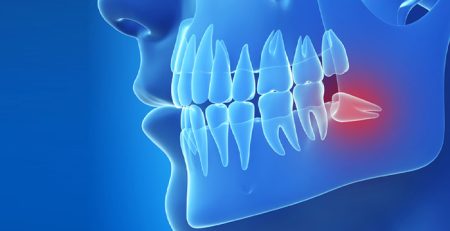
Odontogenic cysts can be developmental or inflammatory in origin. A common example is the radicular cyst. These types of cysts usually develop around the root tip of a tooth that has lost its pulp vitality, in association with a long-standing inflammatory process. A dentigerous cyst, on the other hand, is mostly seen around the crown of an unerupted or impacted tooth. Some cystic lesions, such as odontogenic keratocyst, may require different follow-up and treatment approaches due to their biological behavior and tendency to recur.
In the scientific literature, odontogenic cysts are reported to be one of the common groups of lesions in the jaws, with radicular cysts being among the most frequently encountered subtypes. For current scientific data, a systematic review on the global prevalence of odontogenic cysts can be examined.
How Can a Jaw Cyst Harm a Tooth Root?
The growth of cysts often occurs through the slow reshaping of the surrounding bone. As the cystic cavity expands, pressure can build on the surrounding tissues. If the lesion is close to tooth roots, this pressure can lead to changes in the bone around the root and, in some cases, resorption on the outer surface of the root.
Root resorption is the loss of a portion of the hard tissues that form the tooth root. Contact of a cyst with an adjacent root does not always cause resorption; however, the risk can change as the biological characteristics, size, and duration of contact of the lesion increase. Some cysts may not resorb the root but instead only push the tooth, causing it to displace. Therefore, divergence of teeth, changes in root position, or unexpected positional differences in the dental arch on radiographs are also important findings.
Clinical reviews on odontogenic cysts indicate that cystic lesions can cause destruction in the jawbone and lead to root resorption or displacement in adjacent teeth. For a detailed scientific evaluation on this topic, the academic review titled Odontogenic Cysts can be consulted.
Does Every Jaw Cyst Cause Root Resorption?
No. The presence of a jaw cyst is not the same as the presence of root resorption. A small, slow-growing cyst located far from tooth roots can remain for a long time without causing any damage to the roots. In contrast, root involvement can be observed in large lesions that are in close proximity to the roots or create significant pressure on surrounding tissues.
The type of cyst is also important. For example, while some developmental odontogenic cysts tend to push surrounding teeth more, resorption may be more pronounced in some lesions. Root resorption has also been reported in rarer lesions such as glandular odontogenic cysts. A systematic review reported that tooth displacement and root resorption can be observed in cases of glandular odontogenic cysts. For detailed data, the systematic review of glandular odontogenic cysts can be consulted.
Therefore, an inference like “there is a cyst, the tooth roots are definitely damaged” is not correct. Similarly, the absence of pain does not indicate that the roots are entirely safe. A proper assessment can only be made by examining the lesion’s borders, its relationship with the teeth, and its proximity to surrounding anatomical structures.
Does a Jaw Cyst Resorb a Tooth Root?
The condition commonly referred to as “tooth root erosion” among the public usually describes root resorption. Some jaw cysts can indeed cause resorption on the root surfaces of adjacent teeth. This process can be radiographically observed as shortening, irregularities, or tissue loss in a specific part of the tooth root.
However, the occurrence of root resorption does not necessarily mean that the tooth must be extracted. The degree of resorption, tooth mobility, periodontal support, pulpal status, the cyst’s treatment plan, and the remaining root length are evaluated together. If the root support is sufficient and the tooth is clinically salvageable, it can maintain its function after cyst treatment. If there is advanced root loss, severe mobility, or other accompanying problems, the treatment plan may vary.
Does a Jaw Cyst Kill the Tooth’s Nerve?
The proximity of a jaw cyst to an adjacent tooth does not necessarily mean that the pulp of that tooth has lost its vitality. Some teeth may maintain their vitality even if they appear within or at the border of the cyst. Especially in developmental cysts, pulp vitality should be carefully evaluated to avoid unnecessary root canal treatment of adjacent teeth.
On the other hand, the situation is different with radicular cysts. A radicular cyst is mostly associated with the root apex area of a tooth that has already lost its vitality, is infected, or has suffered severe pulp damage in the past. Therefore, instead of the cyst “killing the nerve” here, in most cases, it is the pre-existing pulp necrosis and chronic periapical inflammation that initiate the cystic process.
Information about root apex lesions and treatment options for infected teeth can be found on the Root Canal Treatment (Endodontics) page.
Can a Jaw Cyst Displace Adjacent Teeth?
Yes. Large cystic lesions, as they grow, may not only thin the bone but also slowly push adjacent teeth in different directions. This can be noticed as gaps forming between teeth, a change in the normal axis of the teeth, or an impacted tooth being pushed to a different position.
Since tooth displacement usually occurs over a long period, the patient may not notice the change in the early stages. Cysts, especially in the posterior regions, can remain silent until a noticeable swelling occurs or a panoramic X-ray is taken. In lesions developing in the anterior region, tooth spacing and swelling may be noticed earlier.
How Do We Know if a Jaw Cyst Has Caused Damage to the Roots?
Involvement of the roots often cannot be definitively assessed solely by intraoral examination. The dentist first listens to the complaints, evaluates the mobility, color change, sensitivity, gingival status, and pulp vitality of the teeth in the affected area. Then, a radiographic examination is performed.
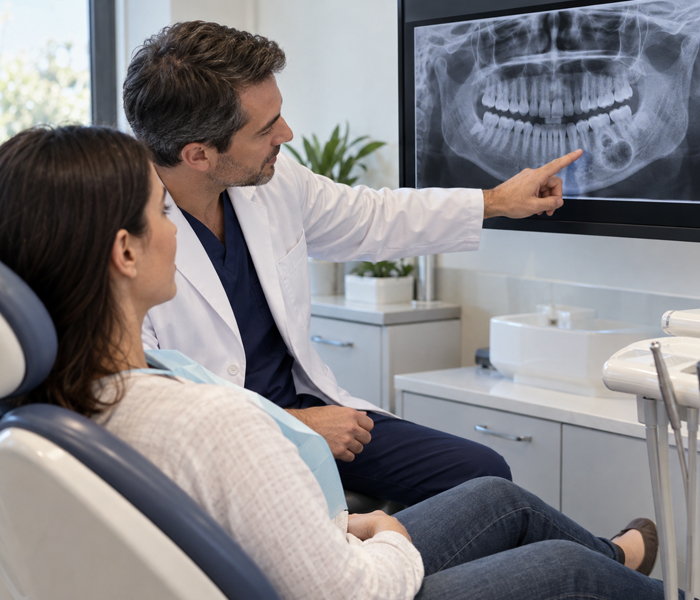
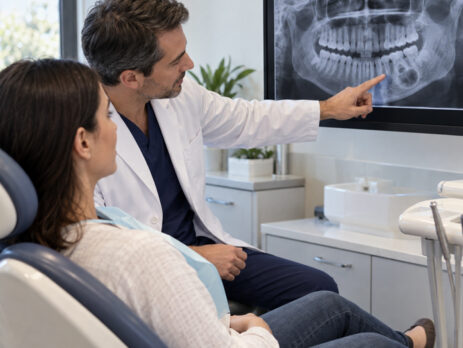
Panoramic radiography can be useful for evaluating a wide area. Periapical radiographs can be used for small periapical lesions or for detailed examination of the root apices of specific teeth. When a detailed evaluation of the cyst’s three-dimensional size, its relationship with cortical bone, its proximity to anatomical structures like the nerve canal, or root resorption is required, cone beam computed tomography (CBCT) may be requested in appropriate cases.
Information about Melsadent’s digital imaging and digital planning approach can be obtained from the Digital Dentistry page.
Is a Panoramic X-ray Sufficient for a Jaw Cyst?
The same imaging method is not sufficient in every case. A panoramic X-ray is an important initial method for showing the approximate location, size, and relationship of the cyst with surrounding teeth. However, in two-dimensional images, anatomical structures can overlap, and the true three-dimensional boundaries of the cyst may not be fully understood.
Three-dimensional imaging may be preferred in cases of suspected root resorption, close relationship with the mandibular canal or sinus floor, a very large lesion, the need for surgical planning, or when panoramic imaging is insufficient. The necessity of CBCT should be determined by the clinician based on the patient and the case; the most appropriate method providing diagnostic benefit is chosen instead of unnecessary imaging.
Can a Jaw Cyst Grow Without Symptoms?
Yes. An important characteristic of jaw cysts is their ability to progress silently, especially when they are not infected. A small cyst can be found without causing any pain, tenderness, or swelling. As the cyst grows slowly, the jawbone can adapt to this change for a while.
When symptoms do occur, complaints may include swelling, a feeling of fullness in the area, displacement of teeth, a change in bite, tenderness, pain, bad taste, discharge, infection, difficulty opening the mouth, or rarely numbness. However, none of these symptoms are exclusive to jaw cysts. Abscesses, tumors, granulomas, or different bone lesions can also cause similar findings.
Therefore, it is not correct to leave intra-jaw radiolucent areas, especially those detected on routine radiographs, unchecked with the thought of “it doesn’t hurt anyway”.
Why Do Jaw Cysts Form?
The cause of jaw cysts varies according to their types. Radicular cysts are mostly associated with chronic inflammatory processes that develop at the root apex after infection and necrosis of the dental pulp. Deep decay, trauma, or previous dental infections can play a role in the onset of this process.
Dentigerous cysts are associated with impacted or unerupted teeth and often develop around the crown of the tooth. Some cysts, such as odontogenic keratocysts, originate from epithelial remnants related to tooth development and may have different clinical behaviors. In addition, non-odontogenic cysts and cyst-like lesions can also be seen in the jaw region.
Therefore, it is not correct to evaluate every cystic area under the same diagnosis by merely looking at an X-ray image.
How Are Jaw Cysts Diagnosed?
The diagnostic process begins with a combined clinical and radiographic evaluation. Numerous characteristics are assessed, such as the patient’s age, complaint, location of the lesion in the jaw, vitality of the affected teeth, presence or absence of impacted teeth, radiographic borders, and whether the lesion appears unilocular or multilocular.
In some cases, the radiographic appearance may strongly suggest a specific type of cyst. However, different odontogenic cysts, benign tumors, and other jaw lesions can resemble each other. Therefore, histopathological examination of surgically removed or biopsied tissue is an important part of definitive diagnosis. Academic sources emphasize that histopathological examination is one of the fundamental diagnostic methods in the evaluation of odontogenic cysts.
What Happens If a Jaw Cyst is Not Treated?
Since the growth rate and behavior of every cyst are not the same, it is not possible to give a specific time frame like “if left untreated, it will definitely cause damage within this period.” However, a cyst that continues to grow can eventually lead to more jawbone loss, thinning of the cortical bone, tooth displacement, root resorption, infection, or encroachment on surrounding anatomical structures.
Large cysts in the mandible can establish a close relationship with neural structures like the mandibular canal. Lesions in the maxilla can expand towards the maxillary sinus. In very large lesions, the mechanical integrity of the jawbone may also be affected. Therefore, early diagnosis is important not only for the treatment of the cyst but also for preserving the surrounding teeth and bone as much as possible.
How is a Jaw Cyst Treated?
Treatment is planned according to the type, size, location of the cyst, the patient’s age, its relationship with adjacent teeth, and the histopathological diagnosis. The most commonly used surgical approaches include enucleation, marsupialization, and decompression.
Enucleation aims at the surgical removal of the cystic lesion in its entirety. It can be preferred for many small and accessible cysts.
Marsupialization aims to reduce the internal pressure in large cysts by creating a controlled connection between the cyst cavity and the oral environment. Thus, the goal can be for the lesion to shrink over time and to support new bone formation in the surrounding area.
Decompression is also a similarly more conservative approach aimed at reducing intracystic pressure. In large lesions, it can be applied as a first-stage treatment to preserve anatomical structures or teeth, and enucleation can be planned later.
For a scientific study examining the effectiveness of marsupialization and decompression in reducing cystic jaw lesions, the systematic review published in the British Journal of Oral and Maxillofacial Surgery can be examined. The research reported that these methods are often used as a first-stage treatment, especially in large lesions, and enucleation can be performed subsequently.
Is Tooth Extraction Necessary in Jaw Cyst Treatment?
No. It is not necessary to extract the affected or adjacent teeth in every patient diagnosed with a jaw cyst. One of the primary goals of treatment is to preserve healthy and functional teeth whenever possible.
When deciding whether a tooth can be preserved, the degree of root resorption, periodontal support of the tooth, mobility, pulp vitality, infection status, the anatomical relationship of the cyst with the tooth, and the ability to remove cyst tissue during surgery are evaluated. In cases where the cyst directly originates from an infected tooth with a poor prognosis, additional procedures such as root canal treatment, apical surgery, or extraction may be considered.
Automatically performing root canal treatment or extracting vital teeth located only near the cyst is not a correct approach. Each tooth should be evaluated individually.
Does Root Resorption Improve After Cyst Removal?
The removal of the cyst can help terminate the ongoing pathological pressure and environmental effect on the root. However, previously lost root hard tissue generally does not return to its original anatomical length. The goal here is to halt progressive damage and preserve the remaining tooth support.
Teeth with sufficient periodontal support can function for a long time despite mild or moderate root resorption. In cases of advanced root loss, the tooth’s prognosis is evaluated more carefully. Therefore, early detection of a cyst can provide an advantage not only for preserving the bone but also for protecting the root length and support of adjacent teeth.
Does Jawbone Regenerate After Cyst Removal?
After a cyst is removed, the jawbone has the capacity for a certain degree of regeneration and healing under appropriate conditions. In small and medium-sized bone cavities, new bone formation can be observed over time. The speed and extent of healing vary depending on the size of the defect, its location, the preservation of surrounding bone walls, the patient’s age, and overall health status.
Systematic studies examining bone healing after enucleation show that the characteristics of the bone defect can affect healing. For a detailed academic source, a systematic review on odontogenic jaw cysts treated with enucleation can be consulted.
Does a Jaw Cyst Recur?
Some cysts may recur after treatment. The risk of recurrence varies depending on the type of cyst, surgical technique, whether the lesion was completely removed, and the patient’s follow-up period. Especially some lesions, such as odontogenic keratocysts, may show a higher tendency for recurrence compared to other simple cysts.
Therefore, histopathological diagnosis along with surgical intervention and the subsequent control program are important. The duration of controls should not be limited solely to wound closure. Long-term radiographic follow-up may be required for some cyst types.
Can a Jaw Cyst Turn into Cancer?
The vast majority of odontogenic cysts are benign and are not cancer. However, different pathological formations resembling cysts may be found in the jaw area. Furthermore, malignant transformation from the epithelium of odontogenic cysts, although extremely rare, has been reported in scientific literature.
Therefore, lesions that grow rapidly, appear with irregular borders, recur, cause numbness, or exhibit unexpected clinical behavior, especially, require detailed evaluation. It is not possible to determine the name and exact type of the cyst solely based on symptoms found online; histopathological examination should be performed if necessary.
Is a Jaw Cyst the Same as a Tooth Abscess?
No. A tooth abscess is generally an accumulation of pus resulting from a bacterial infection and often presents with more acute pain, swelling, tenderness, or systemic symptoms. A cyst, on the other hand, is a pathological cavity surrounded by epithelium and can remain silent for a long time.
However, a cyst can later become infected. In such a case, a lesion that previously showed no symptoms may suddenly cause pain, swelling, a foul taste, or discharge. Therefore, it is incorrect to think that “the swelling went down, the problem is over”; the diagnosis of the underlying lesion should be evaluated separately.
When Should a Dentist Be Consulted for Which Symptoms?
It is beneficial to evaluate the mouth, teeth, and jaw area if one or more of the following findings are present:
- Unexplained swelling in the jaw or gums
- Recurrent abscess or discharge
- Unexplained shifting or spacing of teeth
- Loss of vitality or change in color in a tooth
- A feeling of deep pressure during chewing
- Recurrent problems around an impacted tooth
- A cystic or radiolucent area incidentally seen on an X-ray
- Unexplained numbness or change in sensation in the jaw area
- Persistent pain or a swelling that is progressively growing
These symptoms alone do not confirm a jaw cyst diagnosis. However, early evaluation is important to limit the effect of a possible lesion on surrounding teeth and bone.
Why Is Early Intervention Important in Jaw Cyst Treatment?
When a cystic lesion is small, it may be further away from the surrounding anatomical structures, and surgical planning can be done in a more limited area. As the lesion grows, its relationship with tooth roots, sinuses, nerve canals, or the outer walls of the jawbone can become more complex.
The purpose of early intervention is not to perform unnecessary surgery, but to make a correct diagnosis at the right time and to plan treatment as conservatively as possible. Especially in lesions detected before root resorption begins, more favorable conditions for the preservation of adjacent teeth may arise.
At Melsadent, jaw cysts, impacted teeth, and oral problems requiring advanced surgery are evaluated under Oral, Dental, and Maxillofacial Surgery. The diagnosis and treatment plan are created by considering the patient-specific characteristics of the lesion.
Frequently Asked Questions
Does a jaw cyst erode tooth roots?
Yes, some jaw cysts can cause root resorption in adjacent teeth. However, this is not seen in every cyst. The risk depends on factors such as the type, size, contact with the root, and growth duration of the cyst.
Does a tooth with root resorption always have to be extracted?
No. In cases of mild or moderate root resorption, the tooth can be preserved if it has adequate bone and periodontal support. The decision for extraction is not based solely on X-ray images; it is made based on factors such as mobility, remaining root length, tooth vitality, and overall prognosis.
Can a jaw cyst damage the root without causing pain?
Yes. Some cysts can grow for a long time without showing any symptoms. Therefore, the absence of pain does not guarantee that the surrounding bone or tooth roots are unaffected.
Is a jaw cyst visible on X-rays?
Most jaw cysts can be detected on panoramic or periapical radiographs. However, clinical evaluation, CBCT if necessary, and histopathological examination may be required to determine their exact type.
Is a CT scan mandatory for a jaw cyst?
It is not mandatory in every case. CBCT may be requested when a detailed evaluation of the cyst’s three-dimensional boundaries and its relationship with roots, the nerve canal, or the sinus is needed. The imaging method is chosen based on the case.
Can a jaw cyst be resolved with root canal treatment?
Some inflammatory lesions at the root apex may shrink after successful root canal treatment. However, not all true cystic structures resolve solely with root canal treatment. An endodontic, surgical, or combined approach may be planned after evaluating the source and type of the lesion.
When a cyst is removed, do adjacent teeth also require root canal treatment?
Not always. If adjacent teeth are vital and their pulps are not affected during treatment, they can be preserved without root canal treatment. Vitality tests and radiographic evaluation are important to avoid unnecessary endodontic procedures.
Can a jaw cyst cause teeth to become loose?
If very large cysts reduce the surrounding bone support, mobility may be observed in some teeth. However, since there are other causes for tooth wobbling, such as periodontal disease, differential diagnosis is required.
Does a jaw cyst swell the face?
Large or infected cysts can cause swelling in the jaw and facial area. Small and uninfected cysts, however, may not show any external symptoms.
Does a jaw cyst go away on its own?
A diagnosed jaw cyst should not be assumed to disappear on its own. Some inflammatory periapical lesions may heal after appropriate root canal treatment; however, the management of cystic lesions varies depending on their type. Instead of waiting uncontrollably, a doctor’s evaluation is necessary.
Can a jaw cyst recur?
Recurrence is possible with some types of cysts. Long-term follow-up is particularly important for lesions like odontogenic keratocysts. The risk of recurrence depends on the histopathological type and the treatment applied.
Is a jaw cyst dangerous?
Most jaw cysts are benign. Nevertheless, when they grow, they can cause problems such as bone loss, root resorption, tooth displacement, infection, and pressure on anatomical structures. Therefore, being “benign” does not mean “does not require follow-up.”
Can a tooth with a jaw cyst be saved?
In many cases, yes. Whether a tooth can be saved is related to the type of cyst, the tooth’s vitality, root support, degree of resorption, and the surgical plan. The goal is to preserve the patient’s natural tooth whenever possible.
Are jaw cysts also seen in children?
Yes. Especially dentigerous cysts associated with unerupted permanent teeth can be seen in children and adolescents. When planning treatment for young patients, the preservation of developing teeth and their eruption potential are additionally evaluated.
Do Jaw Cysts Harm Tooth Roots? Short Answer
Jaw cysts can damage tooth roots; however, this is not seen in all cysts and all patients. The most important potential effects are root resorption, displacement of teeth, thinning of the surrounding bone, and in some cases, reduced tooth support. Early detection of the cyst is important for the preservation of surrounding teeth and jawbone.
If a cystic area is observed on an X-ray, or if there is unexplained swelling in the jaw, recurrent infection, displacement or mobility of teeth, a dental evaluation should be performed without delay. A definitive diagnosis is made through clinical examination, appropriate imaging, and, if necessary, histopathological examination. Treatment is planned individually according to the type of cyst and the patient’s anatomical condition.