The Edge of My Filled Tooth Broke, What Should I Do?
The Edge of My Filled Tooth Broke, What Should I Do?
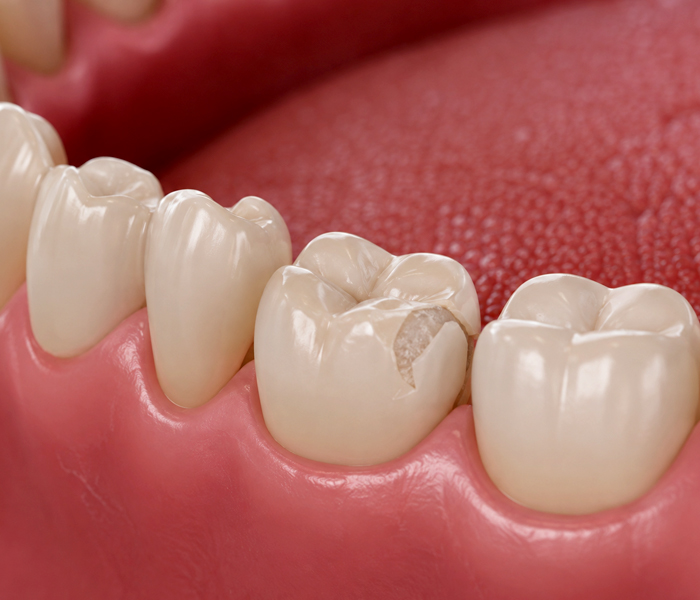
It is quite common for a small or large piece to break off the edge of a tooth that has previously been filled. Sometimes a person feels a hard piece in their mouth while eating, sometimes notices a sharp edge catching their tongue, and sometimes sees missing natural tooth tissue next to the filling when looking in the mirror. In such a situation, the first question that usually comes to mind is “The edge of my filled tooth broke, what should I do?”
A chipped edge of a filled tooth does not always mean the tooth will be extracted or necessarily require root canal treatment. While a small enamel fracture can be corrected with a simple restorative procedure, larger fractures may necessitate a new filling, porcelain inlay/onlay, crown, or in some cases, root canal treatment. To determine the correct treatment, it is necessary to evaluate the size of the fracture, whether the fracture extends below the gum line, the condition of the existing filling, the presence of decay in the tooth, and whether the tooth nerve is affected.
It is important not to delay addressing a fractured filled tooth, even if there is no pain. This is because a fracture that initially appears small can grow over time due to chewing forces. Melsadent Oral and Dental Health Polyclinic’s content on fractured filled teeth and treatment methods also states that different restorative options can be evaluated depending on the extent of the damage.
Did the Filling Itself Fracture, or the Edge of the Tooth?
In cases of fractures in a filled tooth, it is first necessary to determine which structure has been damaged. This is because “the filling fractured” and “the natural tooth next to the filling fractured” are not the same situation.
A portion of the existing composite or amalgam filling might have broken off. While the filling remains fully intact, a piece of the natural tooth structure surrounding the filling might have fractured. Both the filling and the natural tooth structure might have been damaged together. Furthermore, a crack extending into deeper layers of the tooth might be present beneath a fracture that appears small on the surface.
It is generally not possible for the patient to definitively distinguish between these situations merely by looking in a mirror. During a clinical examination, the dentist evaluates the marginal integrity of the filling, the fracture line, the remaining tooth structure, the possibility of decay, and the occlusal relationship. When necessary, radiographic examination, biting tests, periodontal probing, pulp vitality tests, or various other auxiliary methods may be utilized.
It is stated in the scientific literature that the diagnosis of cracked and fractured teeth is not based on a single finding; visual examination, probing, biting tests, and radiological examinations can be evaluated together. You can access a current scientific review on this topic via PubMed.
Why Does the Edge of a Filled Tooth Break?
Dental fillings are applied to restore tooth tissue lost due to decay. However, in a tooth that has been filled, since a portion of the natural tooth tissue was lost previously, the remaining walls may have different durability compared to a sound tooth. Especially in posterior teeth with very large fillings, the remaining thin tooth walls can become more vulnerable to chewing forces over time.
Factors that can cause filled teeth to break include biting hard-shelled foods with the teeth, chewing ice, consistently consuming seeds or hard nuts with the same area, teeth grinding and clenching, very large old fillings, secondary decay developing under or around the filling, trauma, occlusal discrepancies, and material fatigue developing over time.
Furthermore, sometimes the problem doesn’t stem from the filling itself, but from the thin remaining tooth tissue around the filling. Especially in molar teeth, the protruding parts next to the filling, called cusps, can break under intense chewing forces.
What Should Be Done First If a Piece Breaks Off the Tooth Next to the Filling?
When you notice a piece of your tooth has broken off, first try not to chew hard foods with the broken area. You may not need to stop using the tooth entirely, but reducing the load on that area until your examination can help reduce the risk of the fracture worsening.
You can gently rinse your mouth with warm water. If a sharp edge is irritating your tongue or cheek, avoid disturbing the area. If you can find the broken piece, you can store it in a clean container and take it to your dentist. Not every broken piece can be reused, but it can be helpful for the dentist to assess the structure of the fracture.
Household glues, superglue, denture adhesives, or different chemical substances should absolutely not be applied to the broken area. Trying to file, cut, or fix a broken tooth with a sharp tool can also increase the existing damage.
If you think the entire filling has fallen out, you can also check Melsadent’s guide on what to do if a dental filling falls out?
The Edge of a Filled Tooth Broke But It Doesn’t Hurt: Should I Still See a Dentist?
Yes. The absence of pain does not indicate that there is no problem with the tooth. Small enamel and dentin fractures may not cause any pain at first. In fractures that do not reach the nerve tissue, the patient may only notice a sharp edge catching their tongue or food accumulation.
However, if the fractured area is left untreated, the forces on the remaining tooth tissue may change. The fracture could enlarge, leakage might occur at the edge of the filling, or a new cavity could develop in the exposed area. Therefore, the “it doesn’t hurt, I can wait” approach is not always correct.
Especially in molars with large fillings, a seemingly small edge fracture could be the first sign of a more extensive structural problem. Early assessment can, in some cases, allow for the preservation of more natural tooth tissue.
Which Symptoms Are Important When a Filled Tooth Breaks?
Different symptoms may appear in a broken filled tooth. Short-term sensitivity to cold or hot, throbbing in sweet foods, pain when biting, sudden stinging sensation in hard food, pain when biting and releasing, cuts or irritation on the tongue, constant food accumulation between teeth, or sensitivity in the gums may be observed.
Symptoms such as spontaneous throbbing pain, pain that wakes you up at night, pain that increases with heat and does not subside for a long time, swelling in the face or gums, bad taste, or discharge may require a more detailed evaluation of the tooth pulp or surrounding tissues.
For more detailed information about the different causes and treatment options for toothache, you can check the content on what causes toothache?
Can a Small Fracture Next to a Filling Be Repaired with a New Filling?
In many small and medium-sized fractures, direct composite restoration may be possible. However, this decision is not solely based on the visible size of the fracture from the outside.
Important factors evaluated by the dentist include the amount of remaining sound tooth tissue, the size and condition of the existing filling, the presence of decay, the location of the fracture, occlusal forces, tooth grinding habits, and the pulpal status of the tooth.
If the existing filling is generally healthy and the fracture is limited, only the damaged area may be considered for repair. Conversely, if there is decay under the filling, extensive marginal leakage, or a different structural problem, the old filling may need to be removed and the restoration renewed.
Should the Old Filling Be Completely Replaced?
It is not mandatory to replace the entire existing filling in every fracture. In modern restorative dentistry, preserving as much sound natural tooth tissue as possible is an important approach. In some cases where the remaining part of the existing restoration is sound and the damage is limited, a repair option can be considered.
However, if new decay is found under the filling, if there are cracks or leaks in different areas of the filling, if a large part of the restoration is damaged, or if the mechanical strength of the tooth becomes insufficient, it may be more appropriate to completely renew the filling.
Therefore, it is not correct to state a single treatment online, such as “a new filling is definitely needed” or “a crown is definitely required.”
Filling, Onlay, or Crown?
When the edge of a filled tooth breaks, the restoration that can be applied varies according to the amount of remaining sound tooth structure. For small losses, a composite filling may suffice. In cases of larger substance loss, indirect restorations such as inlays or onlays, which can protect the weakened areas of the tooth, especially on the chewing surface, may be considered.
If a significant portion of the tooth has been lost or if the remaining walls are at high risk of fracture, a crown, also known as a dental veneer, can be considered. The aim is not only to fill the fracture cavity but also to provide sufficient structural strength against the chewing forces the tooth will encounter in the future.
In Melsadent’s guide titled filling or crown?, it is explained in detail under which circumstances these two treatments can be considered.
Is Root Canal Treatment Necessary if the Edge of a Filled Tooth Breaks?
Not every broken filled tooth requires root canal treatment. The necessity for root canal treatment is determined by whether the fracture affects the nerve and vascular tissue of the tooth, called the pulp, and by the health of the pulp.
If a small edge fracture only affects the enamel and dentin and the pulp is healthy, root canal treatment may not be necessary. In contrast, if the fracture is very deep, the pulp is exposed, deep decay is present, or the pulp is irreversibly inflamed or has lost its vitality, endodontic treatment is considered.
You can find detailed information on when root canal treatment is applied from Melsadent’s root canal treatment (endodontics) page and from the when is root canal treatment needed? guide.
How Do I Know If a Broken Tooth Has Reached the Nerve?
It is not possible to definitively determine this at home. However, some symptoms may necessitate investigation into a deeper problem. For example, pain that persists long after the hot or cold stimulus is removed, spontaneous throbbing, nighttime pain, significant sensitivity when biting, or discoloration of the tooth are findings that should be noted.
However, a pulp problem may not always cause severe pain. In some teeth, despite the nerve tissue losing its vitality, severe pain may not be observed for a period. Therefore, the decision of whether root canal treatment is needed is not made solely based on the intensity of pain.
My Filled Tooth Hurts When I Bite: Could It Be Cracked?
A short and sharp pain, especially when biting on a hard food or immediately after releasing the bite, is one of the symptoms that can be seen in cracked teeth. However, the same symptom can also occur due to a high filling, a pulp problem, a periodontal issue, or different reasons.
The diagnosis of cracks can sometimes be challenging. Scientific publications indicate that different tools such as clinical examination, bite tests, transillumination, pulp tests, periodontal evaluation, and radiographic methods can be considered together in the diagnosis of cracked teeth. A detailed scientific evaluation of the diagnosis and management of cracked teeth can be found through the comprehensive review on PubMed.
Is a Tooth Fracture from the Edge of a Filling Dangerous?
The severity of the fracture depends on its location and depth. While a superficial enamel fracture might be a simple problem, treatment can become more complex if the crack extends below the gum line or towards the root.
Therefore, it is important to determine the extent of the fracture line, especially in teeth that have previously received large fillings. Scientific studies show that the prognosis of cracked teeth is closely related to pulp status, periodontal findings, crack depth, and the restorative treatment that can be applied.
In a systematic review and meta-analysis published in 2024, the clinical outcomes of cracked teeth after different treatments were evaluated, and it was reported that many teeth treated with appropriate diagnosis and treatment could be preserved. The relevant academic study can be accessed via PubMed.
A Large Piece Broke Off My Filled Tooth, Can the Tooth Be Saved?
Although a large piece breaking off may seem alarming at first glance, this does not automatically mean the tooth will be extracted. Whether the tooth can be saved is evaluated based on factors such as the amount of remaining sound tissue, how far the fracture extends below the gum line, whether there is a root fracture, periodontal support, and the condition of the pulp.
Some large fractures can be reconstructed with appropriate restorative methods. Some may require root canal treatment followed by crown restoration. Conversely, the prognosis for fractures extending deep into the root or preventing restoration may be different.
To learn more extensively about treatment options for fractured natural teeth, you can review Melsadent’s content on what to do if a tooth breaks?
Can a Tooth Break if Decay Continues Under a Filling?
Yes. Secondary decay developing at the edge or under a filling can reduce the durability of natural tooth tissue. Although the filling may still appear to be in place from the outside, the supporting tooth tissue underneath may have weakened. In such a case, a person may unexpectedly experience a piece of the tooth breaking off while chewing something hard.
Therefore, when evaluating the fractured area, not only the missing piece is examined; the edges of the existing filling and the possibility of decay underneath are also investigated. If necessary, the old restoration can be removed to reveal the true condition of the remaining sound tissue.
What Does Restorative Dental Treatment Provide for Fractured Teeth?
The primary aim of restorative dental treatment is not merely to close the resulting cavity. It is to reconstruct the tooth’s anatomy, chewing function, contact with adjacent teeth, and its natural appearance as much as possible.
Depending on the size of the fracture, different options can be considered, from direct composite restorations to indirect restorations. More detailed information about this treatment approach can be found on Melsadent’s cavity and fractured tooth repair – restorative dental treatment page.
What Do Scientific Studies Say About Fractured and Cracked Tooth Treatment?
Studies on the treatment of fractured and cracked teeth show that the same treatment cannot be applied to every patient. Factors such as the location of the fracture, the health of the pulp, the remaining tooth structure, and the periodontal status must be evaluated together.
A comprehensive scientific review on cracked teeth treatment reports positive outcomes with direct or indirect restorative methods, especially in some cracked teeth with healthy pulp or reversible pulpitis.
Another academic study addressing the importance of the diagnostic stage, the article Diagnosis of cracked tooth: Clinical status and research progress, emphasizes the importance of determining the actual extent of the crack for treatment selection and prognosis.
The classical scientific literature on the early diagnosis of cracked and fractured teeth also emphasizes the importance of accurate diagnosis for the tooth’s preservation potential. A review related to the topic, Cracked tooth diagnosis and treatment, is accessible via PubMed.
How Long Can I Wait After a Filling Edge Breaks?
Since it is not possible to definitively determine the degree of the fracture at home, it is not appropriate to give a specific “safe waiting period”. Even if there is no pain, it would be advisable to schedule a dental examination as soon as possible.
Especially after a fracture, assessment should not be delayed if there is pain, swelling, significant sensitivity when biting, prolonged hot-cold sensitivity, a sharp edge constantly injuring tissues, or a feeling that the tooth is moving.
Symptoms such as rapidly increasing facial swelling, fever, or difficulty swallowing or breathing are indications that may require urgent medical evaluation beyond a routine appointment.
Can I Do Temporary Filling at Home?
Temporary materials sold online or recommended in various sources do not replace professional dental treatment. Material placed unknowingly on the fracture may complicate the dentist’s evaluation or cause incorrect bite contacts.
It is especially not appropriate to use household adhesives inside the mouth. Instead of applying adhesive to the tooth, trying to glue the broken piece yourself, or filing the tooth, it is safer to keep the area clean and seek professional evaluation.
Can a Filled Tooth Fracture Recur?
If the underlying cause of the fracture is not eliminated, there may be a risk of recurrence. For example, in a tooth with a very large filling, if only the broken section is restored with a small filling but the mechanical strength of the remaining walls is not adequately assessed, another section may be damaged in the future.
Similarly, in individuals with teeth clenching or grinding habits, restorations may be subjected to more force than usual. In this case, if your dentist deems it necessary, they may suggest protective approaches such as bite assessment or a night guard.
What Can Be Done to Prevent Filled Teeth from Breaking?
One of the primary ways to extend the lifespan of filled teeth is regular oral hygiene and periodic dental check-ups. Early detection of potential decay around the filling can help prevent more significant loss of tooth structure.
It is important to avoid chewing on ice, very hard shells, and objects that should not be broken with your teeth. Habits like opening packages, tearing string, or holding hard objects with your teeth can also lead to unexpected fractures in natural tooth tissue and restorations.
If you suspect you grind or clench your teeth, it is beneficial to share this with your dentist. Furthermore, not neglecting daily tooth brushing and interdental cleaning is crucial for reducing the risk of new decay developing, especially around the edges of fillings.
How Are Filled and Broken Teeth Evaluated at Melsadent?
When the edge of your filled tooth breaks, the treatment to be applied should be determined after a detailed clinical evaluation. The goal is to create a functional, healthy, and long-lasting restoration while preserving as much natural tooth structure as possible.
During the examination, the size of the fracture, the condition of the old filling, the remaining sound tooth walls, the possibility of decay, the vitality of the tooth, and occlusal forces are evaluated. In necessary cases, radiographic examinations may be utilized.
While a composite restoration may suffice for small fractures, different restorative options might be considered for more extensive loss of tooth structure. If the pulp is affected, root canal treatment may become necessary. Therefore, the treatment plan is formulated not only based on “the size of the broken fragment” but on the tooth as a whole.
What is the Most Important Point if the Edge of My Filled Tooth is Broken?
The most important point is not to leave the tooth unchecked for a long time, relying on the fracture appearing small or not causing pain. While some fractures in filled teeth can be easily repaired, some fractures may indicate broader structural problems.
Through early examination, it can be assessed why the tooth broke, whether the existing filling can be preserved, whether a new filling is needed, whether it is appropriate to strengthen the tooth with an onlay or crown, and whether the pulp is healthy.
In summary; if the edge of your filled tooth is broken, reduce chewing hard food on that side, do not tamper with the area, do not apply any adhesive to the tooth, and schedule a dental examination as soon as possible.
Frequently Asked Questions
The edge of my filled tooth broke, should I go to the dentist immediately?
It is recommended to have it evaluated as soon as possible. The absence of pain does not mean the fracture is insignificant. Small fractures can enlarge over time, or sensitivity and decay can develop in the exposed area.
A small piece of tooth broke off next to the filling, can it be refilled?
If the fracture is limited, sufficient sound tooth tissue is present, and the existing restoration is in good condition, repair with a composite restoration may be possible. The final decision is made after a clinical examination.
The filling is intact, but the tooth itself broke. Is this normal?
Especially in teeth with large fillings, the thin natural tooth walls remaining around the filling can fracture over time. This situation may be related to consuming hard foods, teeth grinding, decay, or intense chewing forces.
Can a broken filled tooth be extracted?
Not every broken filled tooth is extracted. Many teeth can be preserved with methods such as fillings, onlays, veneers, or, if necessary, root canal treatment. The decision for extraction is only considered when the tooth cannot be restoratively saved.
Is root canal treatment mandatory when a filled tooth breaks?
No. Root canal treatment may only be necessary if the fracture affects the pulp tissue or if the pulp is irreversibly damaged. Superficial fractures may not require root canal treatment.
The edge of my filling broke, but there’s no pain. Can I wait?
The absence of pain does not guarantee that there is no significant damage. A dental check-up is recommended to evaluate the size of the fracture and the remaining tooth structure.
What does it mean if a broken filled tooth aches with hot and cold?
Exposed dentin tissue can cause sensitivity. However, prolonged or spontaneous pain requires evaluation of the pulp as well. A definitive diagnosis cannot be made at home based on symptoms.
My filled tooth broke while eating, can I eat on that side?
Until the examination, it will be safer not to chew especially hard and sticky foods with the broken tooth. Applying extra force to the remaining tooth structure can cause the fracture to expand.
The sharp edge of my broken tooth is cutting my tongue, what should I do?
Do not file or cut the area yourself. The sharp edge needs to be professionally smoothed and evaluated for a larger fracture underneath.
Should I keep the broken tooth fragment?
If you can find it, you can keep it clean and take it to your dentist. Reusing the fragment is not always possible, but it can help the dentist evaluate the nature of the fracture.
Could a tooth break due to decay under an old filling?
Yes. Decay developing at the edge or under a filling can weaken the natural tooth structure. Even if the filling appears sound from the outside, the supporting tissue underneath may have been lost.
When a filled tooth breaks, is a crown better, or a filling?
There isn’t a single correct option. While a filling may be sufficient for small fractures, an onlay or crown might be more appropriate for extensive loss of tooth structure. The remaining sound tooth structure, the location of the fracture, and chewing forces are decisive factors in treatment selection.
Can teeth grinding/clenching at night break a filled tooth?
Teeth clenching and grinding can exert high forces on teeth and restorations. This condition can be one of the factors that increase the risk of fracture, especially in teeth with large restorations or those that are structurally weakened.
Does a fracture at the edge of a filling heal on its own?
No. Lost enamel and dentin tissue in an adult tooth does not naturally regenerate its original anatomical form. Depending on the size of the fracture, restorative treatment may be necessary.
Does a fractured filled tooth cause an abscess?
The fracture itself does not always directly cause an abscess. However, if the fracture or a deep cavity underneath leads to infection of the pulp tissue, an infection can develop around the root over time. If there is swelling, a bad taste, discharge, or severe pain, an evaluation should be done without delay.
What can be done to prevent a filled tooth from breaking again?
Choosing an appropriate restoration for the tooth’s structure, maintaining oral hygiene, avoiding breaking hard objects with teeth, not neglecting regular check-ups, and addressing any teeth clenching or grinding issues can help reduce the risk of re-fracture.
Get a Fracture in a Filled Tooth Checked Even if it Appears Small
“The edge of my filled tooth broke, what should I do?” There is no single treatment answer to this question. While a small fracture can be repaired with a simple composite restoration, more extensive material losses may require solutions such as inlays, onlays, or crowns. In cases where the pulp is affected, root canal treatment may be considered.
The most important issue here is early and accurate diagnosis. The size of the fracture, the condition of the existing filling, the presence of decay, the vitality of the tooth, and the remaining sound tooth tissue should be evaluated together. This way, a treatment plan aiming to preserve the long-term function of the tooth can be created, instead of just addressing the current fracture.
If a piece of your filled tooth has broken off, if sensitivity has started in the fractured area, or if a sharp edge bothers your tongue, you can schedule an examination appointment at Melsadent Oral and Dental Health Polyclinic to have your tooth’s condition professionally evaluated.
Note: This content has been prepared for general informational purposes and does not replace a personal dental examination or diagnosis. Treatment options can only be determined after a clinical and, if necessary, radiographic evaluation.