What to Do if a Tooth Breaks? Can a Broken Tooth Be Saved?
What to Do If a Tooth Breaks? Can a Broken Tooth Be Saved?
What to Do If a Tooth Breaks?
Tooth fractures are among the most common dental traumas in children and adults. Sports injuries, falls, traffic accidents, consumption of hard foods, or teeth weakened by decay can lead to fractures. A tooth fracture is not just an aesthetic problem; it can also lead to serious consequences, progressing to pain, infection, and even tooth loss.
The first intervention when a tooth breaks significantly increases the chance of saving the tooth. Therefore, knowing what to do in which situations is of great importance. In this article, we cover in detail the first aid steps to be applied after a tooth fracture, treatment options, and points to consider.
Why Do Teeth Break?
Although teeth are one of the hardest tissues in the human body, they can break in some circumstances. Especially the following factors increase the risk:
- Traumas resulting from falls and impacts
- Sports injuries
- Traffic accidents
- Consumption of hard-shelled foods
- Teeth grinding and clenching (bruxism)
- Advanced decay
- Old and large fillings
- Weakened teeth that have undergone root canal treatment
The risk of fracture is much higher in teeth weakened especially due to decay. Therefore, regular dental check-ups should not be neglected.
What Should Be Done First When a Tooth Breaks?
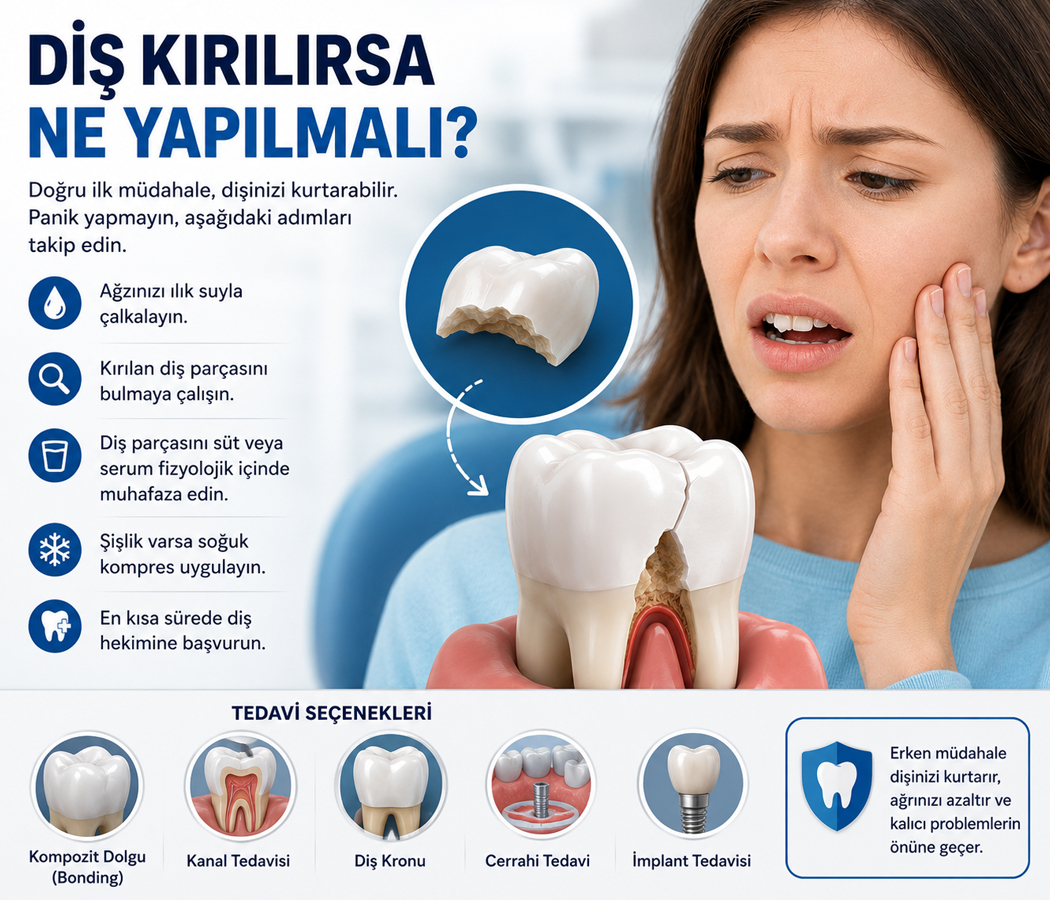
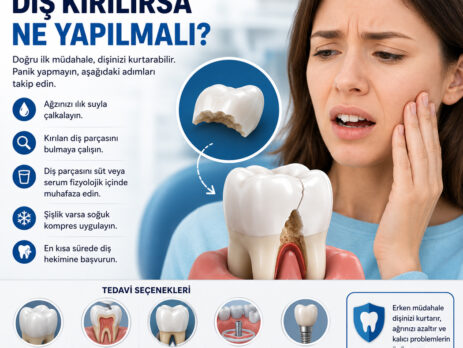
Do not panic when a tooth breaks. The correct interventions made within the first few hours can directly affect the success of the treatment.
- Gently rinse your mouth with clean water.
- Try to find the broken tooth fragment.
- Do not let the tooth fragment dry out.
- If there is bleeding, apply pressure with a sterile gauze pad.
- If swelling occurs in the facial area, apply a cold compress.
- Consult a dentist as soon as possible.
The broken tooth fragment should be preserved in milk, physiological saline, or the person’s own saliva. This way, in some cases, it may be possible to reattach the broken fragment.
What Are the Symptoms of a Tooth Fracture?
Symptoms may vary depending on the size of the fracture.
- Feeling a sharp edge
- Sensitivity to hot and cold
- Pain while chewing
- Bleeding in the gums
- Visible crack or fracture in the tooth
- Severe throbbing pain
- Change in tooth color
Some micro-cracks may not show symptoms initially. However, pain and sensitivity may develop over time.
How Are Tooth Fractures Classified?
Tooth fractures can occur at different levels.
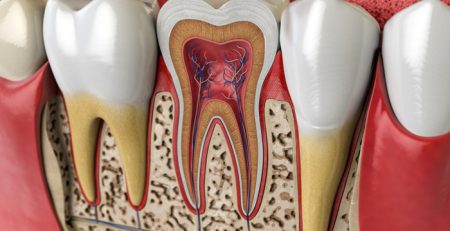
Enamel Fractures
Only the outermost layer of the tooth is affected. It usually does not cause pain and is easily treated with aesthetic filling.
Dentin Fractures
The fracture has reached the dentin, which is the second layer of the tooth. Hot-cold sensitivity may be observed.
Fractures Exposing the Pulp
The pulp tissue, where the tooth nerves are located, has been exposed. Severe pain may be experienced, and root canal treatment is often necessary.
Root Fractures
These are fractures that occur in the tooth root. The treatment plan varies according to the level of the fracture.
What to Do if a Front Tooth Breaks?
Front tooth fractures are among the traumas that most affect patients, both aesthetically and psychologically. They are especially common in children and young adults.
With early intervention for front tooth fractures, a natural appearance can often be restored. Aesthetic results can be achieved with composite bonding applications, porcelain veneers, or crown treatments.
In cases of trauma to the front teeth, a specialist dentist should be consulted without delay.
What to Do if a Child’s Tooth Breaks?
Dental traumas resulting from falls and impacts are quite common in childhood. Regardless of whether it’s a primary tooth or a permanent tooth, a dental evaluation is absolutely necessary.
After trauma, the tooth may have shifted, become loose, or fractured. Early intervention is especially important for the preservation of permanent teeth.
The follow-up process after trauma in children is also an important part of the treatment.
Which Treatments Are Applied After a Tooth Fracture?
The treatment method is determined according to the size of the fracture and how much the tooth tissue is affected.
Composite Filling and Bonding
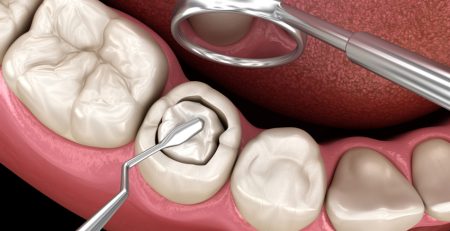
For minor fractures, the tooth can be restored to its original appearance using aesthetic composite materials.
Root Canal Treatment
If the broken tooth has reached the nerve tissue, root canal treatment may be necessary. This way, the tooth can be preserved in the mouth without extraction.
Dental Crown
For teeth with significant loss of substance, zirconium or porcelain crowns may be preferred. This method strengthens the tooth while restoring its aesthetic appearance.
Surgical Treatment
Surgical procedures may be required for advanced fractures at the root level.
Implant Treatment
In cases where the tooth cannot be saved, implant treatment after extraction can offer a long-term solution.
What Happens If a Broken Tooth Is Not Treated?
Broken teeth can lead to more serious problems over time.
- Severe pain may develop
- The tooth may become infected
- An abscess may form
- Tooth loss may occur
- Damage to the jawbone may occur
- Aesthetic problems may arise
Therefore, even for a small fracture, a professional evaluation should be carried out.
What Can Be Done to Prevent Tooth Fractures?
- Avoid breaking hard objects with your teeth.
- Have your regular dental check-ups.
- Treat cavities without delay.
- Use a mouthguard when playing sports.
- If you have a teeth grinding problem, use a night guard.
- Brush your teeth regularly and use dental floss.
Broken Tooth Treatment at Melsadent
At Melsadent Oral and Dental Health Polyclinic, broken tooth cases are evaluated in detail using digital imaging systems. Depending on the size of the fracture, aesthetic fillings, bonding, root canal treatment, crown applications, or implant treatments are planned.
Our aim is to preserve the natural tooth as much as possible and achieve long-lasting results.
Frequently Asked Questions
Can a broken tooth be restored to its original state?
Yes. Depending on the size of the fracture, results very close to the natural appearance can be achieved with bonding, fillings, crowns, or other restorative procedures.
Does a broken tooth heal on its own?
No. Tooth tissue cannot regenerate itself. Professional treatment is absolutely necessary.
Should a broken tooth fragment be kept?
Yes. Tooth fragments stored under appropriate conditions can be reattached in some cases.
Is a tooth fracture an emergency?
Yes. Especially if there is pain, bleeding, or an exposed nerve, a dentist should be consulted as soon as possible.
Is a broken tooth extracted?
Not every broken tooth is extracted. Today, many broken teeth can be saved with root canal treatment, crowns, or restorative methods.
Can a fractured front tooth be aesthetically corrected?
Yes. Highly natural results can be achieved with composite bonding, laminate veneers, or zirconium crown applications.
Are fractured primary teeth in children treated?
Yes. They must be examined by a pedodontist to assess whether the trauma has affected the permanent teeth.
Academic Resources
American Association of Endodontists – Traumatic Dental Injuries
NCBI Bookshelf – Tooth Fracture
Related Articles
- Repair of Decayed and Broken Teeth
- Root Canal Treatment (Endodontics)
- What to Do if a Filling Breaks?
- Oral, Dental and Maxillofacial Surgery
- Implant Treatment
- First Aid and Follow-up for Dental Traumas in Children
- Dental Crowns