Why does root-treated tooth hurt after years?
Why does root-treated tooth hurt after years?
Although the root canal treatment does not cause any problems for months or even years, it can cause anxiety in many patients. Since it is known that the nerve tissue in the tooth is removed, especially during root canal treatment, “How can a nervous tooth hurt after years?” The question is asked quite often.
In root canal treatment, the nerve and vascular tissue called the pulp in the tooth is cleaned. However, the periodontal ligament surrounding the tooth root, the jawbone, the gums and other tissues around it maintain their vitality. Pain may be felt in a tooth with canal treatment due to infection, inflammation, excessive pressure, cracks or root fractures that may occur in these tissues.
To answer briefly; The cause of the pain of a root canal treatment after years may be the infection that regenerates at the root tip, bacterial leakage caused by a canal, filler or coating that is not noticed in the first canal treatment, may be a tooth crack, vertical root fracture, tooth clenching, tooth clenching, periodontal diseases or reflected pain from neighboring teeth.
For this reason, the pain that starts later in a tooth with canal treatment, which has not caused any complaints for years, should be considered normal and should not be waited for a long time. Clinical examination and necessary radiographic evaluations are important to determine the source of the pain.
For more detailed information on how root canal treatment is applied and in which situations it is needed, CHANNEL#ATFP_CLOSE_TRANSLATE_SPAN# Treatment (Endodontics) You can view the page.
Where does the pain come from if the root canal treatment does not have nerves?
Although the nerve tissue in the tooth is removed in canal treatment, the tooth does not become a completely numb structure. The tissues surrounding the tooth root contain nerve endings that can perceive pressure, touch and pain.
In particular, the connective tissue called the periodontal ligament is located between the tooth root and the jawbone. When infection or inflammation develops at the root end, nerve endings in this area can be stimulated. For this reason, a root canal can cause pain, especially when pressed, chewing or clenched teeth.
In other words, the onset of pain again with canal treatment does not mean that there is a nerve in the tooth. The source of pain is mostly living tissues surrounding the tooth.
Is the pain normal years after root canal treatment?
Mild sensitivity, which can be seen within a few days after root canal treatment, and pain that occurs months or years after treatment should be evaluated differently.
Immediately after root canal treatment, transient sensitivity may occur in the tissues around the root. Slight pain, which can last for a few days, especially when pressed on the tooth, can be seen in some patients. For detailed information about the sensitivity seen immediately after root canal treatment Is the pain normal after the channel#atfp_close_translate_span# treatment? You can review the content.
However, it is not a part of the routine healing process that a tooth-treated tooth starts to hurt again afterwards, which has not caused any problems for years. In such a case, it should be evaluated whether there is a newly developing dental or periodontal problem.
What are the most common causes of root canal treatment teeth after years?
Pain that occurs long after root canal treatment is not due to a single cause. The shape of the pain, when it started, whether it increases with chewing, whether there is swelling and radiographic images should be evaluated together.
The most frequently evaluated causes include infection at the root tip, untreated canal, restoration leaks, cracks, root fractures, periodontal disease and extreme chewing forces.
1. Re-infection at the root tip
One of the most important causes of canal treatment teeth re-pain after years is infection that develops or continues at the root end. This condition may be associated with apical periodontitis of endodontic origin.
The main purpose of root canal treatment is to remove the microorganisms in the root canals as much as possible, to disinfect the canal system and to fill it in a way that prevents the re-entry of bacteria.
But the root canal system does not consist of only one and straight canal. Especially in molars, there may be lateral canals, very thin branches, folds, indentations and anatomical variations. It may not always be possible to reach all of these regions mechanically.
Microorganisms living in the canal or around the root can remain without any symptoms for a long time. When bacterial activity increases over time, inflammation may develop in the tissues at the root tip.
In this case, sensitivity when pressed on the tooth, pain during chewing, throbbing from time to time, swelling in the gums or a small discharge path can be seen.
2. Presence of an undetected channel in the first canal treatment
The canal anatomy of each tooth may be different from each other. Even in the same type of teeth, the number of canals, the shape and root structure of the canal may vary from person to person.
In particular, molars can have quite complex canal anatomy. During the first canal treatment, the additional canal in a very thin, narrow, curved or unexpected area may not be noticed.
Microorganisms that remain in the untreated canal can multiply over time and cause infection around the root. Interestingly, this condition can show symptoms not immediately after the first treatment, but months or years later.
The American Association of Endodontists also shows narrow or curved ducts that cannot be noticed during the first treatment, among the reasons for a tooth that has been treated before the need for re-treatment. Detailed scientific and clinical information on the subject American Association of Endodontists – Endodontic Retreatment available from the source.
3. Bacteria leak from old fill or coating
In order to maintain a successful root canal for many years, it is important not only to clean the root canals, but also to restore the upper part of the tooth properly.
Filling or coating made after root canal treatment may wear, break or lose edge compatibility over the years. Especially the development of new caries under the coating or the formation of a void on the edge of the filling may cause bacteria to reach the tooth again.
This condition can be called coronal leakage. Bacteria can reach the canal system from the upper part of the tooth and pave the way for the development of infection at the root end.
If a root canal and coated tooth has started to hurt for many years, not only the root canal filling, but also the condition of the existing coating or filling should be checked.
Melsadentin to find out the different causes of pain that may occur under the coating Tooth#AtFP_Close_Translate_Span# What causes pain under the coating? You can also review the content.
4. Cracked tooth formation in root canal treatment
Cracks in root canal treatment over the years can also cause pain. It may be necessary to evaluate for cracks, especially in teeth that are largely filled, have suffered serious substance loss or are exposed to high chewing forces.
The diagnosis of tooth cracks can be difficult in some cases. Because small cracks may not always be seen on standard dental radiographs.
The patient can often talk about a short and sharp pain that occurs when he bites a hard food. In some people, pain only occurs during chewing at a certain angle.
It is important for treatment planning in which part of the crack the crack is located and whether it progresses to the root.
Scientific studies evaluating the prognosis of endodontic-treated cracked teeth Pubmed – Outcomes of Endodontically Treated Cracked Teeth You can reach via.
5. Vertical Root Fracture
Vertical root fracture is the type of fracture that occurs along the long axis of the tooth root, and it is one of the important reasons that should be evaluated, especially in teeth that have been treated with root canal treatment.
Continuous or intermittent pain in a tooth with vertical root fracture, tenderness during chewing, local swelling, discharge tract on the gingiva or deep periodontal pocket in a particular area may occur.
However, vertical root fractures may not always be clearly displayed on standard radiography. Therefore, clinical findings and imaging results are evaluated together.
Systematic review and meta-analysis, which evaluates clinical manifestations of root-treated teeth with vertical root fracture Pubmed – Vertical Root Fact Systematic Review and Meta-Analysis You can reach from the link.
6. Threading and teeth grinding
Infection is not always the cause of a toothache with root canal treatment. The habit of clenching or grinding teeth, called bruxism, can cause excessive force exposure of the tissues surrounding the tooth root.
Especially people who clench their teeth during the night may feel pressure, tenderness or pain during chewing in their teeth with canal treatment when they wake up in the morning.
In this case, the root canal treatment itself may not be a problem. It should be evaluated whether the tooth receives more load from other teeth at closing.
7. High fill or coating
When the teeth are closing, if the root canal-treated tooth comes into contact with other teeth before, more than normal force may be placed on the periodontal ligament.
This can cause pain, especially when pressed on the tooth. Patients often describe it as “It doesn’t hurt when it’s normal, but it hurts when I step on it while eating”.
During the closing control, the contact points can be evaluated and it can be determined whether the tooth is overloaded.
8. Gum and bone-related problems
The source of pain around the tooth with canal treatment may sometimes be periodontal tissues, not the root canals of the tooth.
Gum disease, periodontal pocket formation, tartar accumulation, local gingival infection or loss of support in the jawbone can cause pain and tenderness around a tooth with root canal treatment.
Therefore, the evaluation should not focus solely on the quality of root canal therapy. Gingival, periodontal pocket depth, mobility and surrounding bone tissue should also be checked.
9. Pain may actually come from the neighboring tooth
It is not always possible for the person to determine the source of toothache with certainty. Pain may be reflected in the neighboring teeth, especially in the teeth in the posterior region.
Since the patient had had root canal treatment in the past, he may think that the pain is automatically caused by this tooth. However, the tooth next to it may have deep caries, pulp infection, cracks or periodontal problems.
For this reason, it is also important to evaluate neighboring teeth with vitality and sensitivity tests when a canal treatment is in pain.
For more information about different causes of toothache How does the tooth#atfp_close_translate_span# go away? You can review the guide.
10. Sinus-induced pain may be confused with toothache
Especially the roots of small and large molars in the upper jaw may be close to the maxillary sinus region. Inflammation in the sinuses may cause pain or pressure in the upper posterior teeth in some patients.
Non-dental pain sources should also be evaluated in case of simultaneous sensitivity in more than one upper back tooth, changes in pressure with head movements and congestion of nasal congestion.
Why does it hurt when you press on the root canal treatment tooth?
Pain is one of the most frequently investigated complaints when pressed on the root canal treatment or while eating.
This may be due to the sensitization of periodontal tissues around the root. Conditions such as apical inflammation, root tip infection, tooth crack, high filling or veneer, clenching and vertical root fracture can cause pain during chewing.
The occurrence of pain only by pressure does not make a definitive diagnosis alone. The tooth should be evaluated with clinical examination and radiographic imaging.
Why does root-treated tooth start throbbing?
A throbbing pain in a tooth with root canal treatment may suggest that there may be active inflammation or infection in the tissues around the roots.
Dentist evaluation should not be delayed, especially if throbbing is accompanied by swelling, tenderness in the gums, bad taste, discharge or swelling in the face area.
However, throbbing of pain alone is not enough to diagnose infection.
What causes swelling at the bottom of the root of the canal treatment?
Occasionally, the disappearance of a small blister that looks like a pimple in the gum near a root canal can be associated with a chronic root tip infection.
In some cases, this bubble may be a drainage pathway that allows the fluid in the infection site to drain into the mouth. Therefore, the pain may be temporarily reduced after the bubble appears.
However, a decrease in pain does not indicate that the infection has completely healed. It is necessary to determine the source and plan the necessary treatment.
Is swelling dangerous in root canal treatment?
Swelling around a tooth with root canal treatment is a condition that needs to be evaluated. Especially in the event that the swelling grows rapidly or spreads to the face area, a health institution should be applied without delay.
If there are symptoms such as fever, general condition disorder, pronounced difficulty in mouth opening, difficulty in swallowing or difficulty in breathing, the situation may require a more urgent assessment.
Antibiotics are not required in every dental infection, while antibiotics alone do not eliminate the source of the infection in the root canal. Antibiotics should be used in line with the dentist’s evaluation.
How to detect if old root canal treatment has failed?
The success of root canal treatment is not evaluated only by checking whether the tooth aches or not. Although some teeth have a radiographic problem at the root tip, the patient may not feel any pain.
Symptoms that can be evaluated in a tooth with root canal treatment include:
- Pain or tenderness when pressed on the tooth
- Feeling discomfort during chewing
- Recurrent swelling of the gums
- Acne-like blisters on the gingiva
- Fracture or leakage in the coating or filler
- A lesion on the root end of the radiography
- Untreated area in the canal
- Deep periodontal pocket formation in a specific area
- Suspicion of cracks or root fractures in the tooth
The presence of any of these symptoms alone does not mean that root canal treatment is unsuccessful. The diagnosis is made by evaluating clinical and radiographic findings together.
How is the root canal treated tooth diagnosed when it hurts years later?
The diagnosis process first begins with the patient’s description of pain in detail. It is important when the pain starts, whether it is continuous or intermittent, whether it increases when pressed on it, whether there is throbbing or not, and whether there has been swelling before.
Clinical examination of the tooth can then be performed. Percussion, palpation, periodontal probing, mobility and closing assessments can help determine the source of pain.
It is also checked whether there is a different problem in the neighboring teeth.
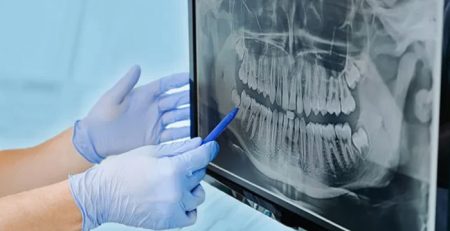
Dental radiographs can be used to assess the condition of the current canal filling, the bone tissue at the root tip, and possible areas of infection.
In some complex cases, if the standard two-dimensional images are considered not sufficient, three-dimensional dental imaging methods can be used if the physician deems it necessary.
For more information about digital applications used in Melsadent Digital#atfp_close_translate_span# dentistry You can view the page.
Is CT scan required for every old canal-treated tooth?
No. Three-dimensional dental tomography or CBCT is not routinely used in every canal-treated toothache.
The first evaluation is usually made with clinical examination and appropriate dental radiographs. However, in case of symptoms that cannot be explained by standard images, complex canal anatomy, untreated canal suspicion, or some suspected root fractures, the physician may need a CBCT evaluation.
The selection of the imaging method should be made according to the clinical condition of the patient.
Can root canal treatment be applied to the root canal treatment?
Yes. In case of re-infection in a tooth that has been treated before, or if the existing treatment is not sufficient, root canal treatment can be applied in appropriate cases.
This procedure can be called endodontic retreatment or root canal therapy regeneration.
Old canal filling materials are removed in re-canal treatment. The root canal system is re-evaluated, if any, channels that have not been noticed before are investigated, the channels are cleaned and disinfected again.
Then the root canals are refilled with suitable materials and the upper restoration of the tooth is planned.
Systematic review evaluating the results of contemporary non-surgical endodontic re-treatments Pubmed – Outcome of Contemporary Nonsurgical Endodontic Retreatment You can reach via.
It should be noted that the success rates reported in scientific publications do not mean a guarantee for every patient or every tooth. The result depends on the initial state of the tooth, root structure, current infection, restoration and many clinical factors.
Re-canal treatment or apical surgery?
When an infection or lesion that does not heal at the root end is detected, the same treatment is not applied in every patient.
In some cases, it is appropriate to redo root canal treatment, but in some cases, endodontic surgery known as root tip surgery can be evaluated.
Which method will be preferred re-accessibility to the channel system depends on the current restoration, root anatomy, the location of the lesion, the restorative state of the tooth and other clinical factors.
Scientific examination evaluating surgical and non-surgical re-treatments in teeth with apical periodontitis Pubmed – Root Canal Retreatment Versus Apical Surgery can be accessed from the link.
If the root canal treatment is aching, should it be removed?
No. Re-paining of a root canal treatment does not necessarily mean that the tooth will be removed.
If the current condition of the tooth is appropriate, re-canal treatment, restoration, periodontal treatment, closing arrangement or endodontic surgery options in appropriate cases can be evaluated.
On the other hand, in cases where there is an untreatable level of root fracture, advanced periodontal support loss or restoratively unrecoverable amount of tooth tissue loss, shooting may be on the agenda.
To find out in which situations the canal treatment and shooting option are evaluated for tooth protection. channel#atfp_close_translate_span# treatment or tooth extraction? You can review our content.
What can be done at home in root canal treatment?
Methods that can be applied at home do not eliminate the root cause of pain. Painkillers may provide temporary relief in suitable people, but the treatment of the underlying dental problem does not replace it.
Drug use should be taken by taking into account the current diseases of the person, allergies, other drugs he uses and the recommendations of the physician.
It may be beneficial not to chew hard foods with aching teeth and to maintain oral hygiene.
Aspirin, cologne, alcohol or irritating substances should not be applied on the tooth.
Suppressing pain that has just begun on a tooth-treated tooth, which has not been a problem for years, with constant painkillers, can cause a delay in the diagnosis.
What can be done to keep the root canal treatment tooth healthy for many years?
Completion of root canal treatment does not mean that the tooth does not need to be checked again. It is also important to regularly check the root canal treatment teeth.
- Do not delay regular dental check-ups
- Checking when a break in the filling or coating is noticed
- Maintaining daily tooth brushing habits
- Regular cleaning of teeth
- Avoid breaking very hard substances with teeth
- Consulting a doctor if there is a suspicion of clenching or grinding
- Caring about the new sensitivity during chewing
- Checking recurrent swelling or blisters in the gums
How is MELSADENTE Evaluated Toothache with Canal Treatment?
When a root canal-treated tooth starts to hurt again after years, the important thing is not only to temporarily reduce the pain, but also to determine the real source of the pain.
In the evaluation of canal treatment teeth in MELSADENT Oral and Dental Health Polyclinic, existing canal filling, upper restoration of the tooth, tissues around the root, gum health, closing relationship and neighboring teeth can be evaluated together.
When necessary, the root canals and the surrounding bone tissues can be examined by using radiographic imaging methods.
In line with the clinical and radiographic findings obtained, the preservation of existing canal treatment, regeneration of restoration, re-canal therapy, periodontal treatment or other suitable options can be evaluated.
Frequently Asked Questions
Can root canal treatment tooth hurt after 5 years?
Yes. A root canal can be re-painted after 5 years or more after treatment. Causes such as new infection, restoration leakage, cracks, clenching or periodontal problems should be evaluated.
Can root canal treatment tooth ache after 10 years?
Yes. The fact that the time elapsed after the canal treatment is long does not mean that a new problem will not develop in the tooth. New dental or periodontal problems may also occur in a root canal-treated tooth that has been used for ten years or more without any problems.
Why does it hurt when you press on the root canal treatment tooth?
Inflammation around the root, apical infection, tooth crack, tooth clenching, high closing or pain can cause pain when pressed on the root fracture.
Is there a re-infection in the root canal treatment?
Yes. Microorganisms remaining in the canal or new bacterial leakage caused by filling and coating over the years can cause re-infection.
Canal Treatment Tooth Zones?
The presence of active inflammation or infection around the root can cause throbbing pain. However, throbbing alone does not make a definitive diagnosis of infection.
Is there a hot and cold sensitivity in root canal treatment?
Since the pulp tissue is removed in a tooth whose root canal treatment has been completed, classical pulpal hot-cold sensitivity is not expected. In such a complaint, neighboring teeth or different sources of pain should also be evaluated.
Why does acne occur in the flesh of the root canal treatment?
A recurrent small bubble or discharge tract on the gingiva may be associated with a chronic infection around the root. Even if the pain is not found, it should be evaluated by the dentist.
Can root canal treatment be renewed?
Yes. In suitable cases, the root canals can be re-cleaned, disinfected and filled by removing old canal filling materials.
Can root canal treatment be done for the second time?
Yes. Re-canal treatment can be applied to the same tooth under appropriate conditions. Whether the treatment is appropriate or not is evaluated according to the current condition and root structure of the tooth.
Can root canal treatment be used if the tooth hurts?
Antibiotics are not required for every root-treated toothache. The cause of the pain can be different conditions such as cracks, high closing or teething, apart from infection. Antibiotics should be used only when necessary, with the recommendation of a physician.
Is the treatment unsuccessful if the tooth with root canal treatment hurts?
No. Pain may be associated with root canal treatment, or it may be caused by periodontal disease, clenching, cracks, neighboring teeth or non-dental structures.
If the root canal treatment is aching, can it be removed immediately?
No. First of all, it is evaluated whether the tooth is recoverable. In appropriate cases, re-canal therapy or different tooth preventive treatments can be applied.
What should be done if there is swelling in the root canal treatment?
Canal-treated dental dentist should be evaluated by the dentist. An emergency health assessment is required if there are symptoms such as rapid growth of swelling, spreading to the face, fever, swallowing or difficulty in breathing.
If the root canal treated tooth hurts after years, it should not be neglected.
The pain of a root canal treatment after years does not mean that nerves are formed in the tooth again. Pain is mostly caused by living tissues surrounding the root or different structures associated with the tooth.
Root end infection, bacterial leakage from the duct, coating or filler that was not noticed in the first treatment are among the possible causes of pain that occurs years later.
However, the real source of pain may not always be the old canal-treated tooth. Neighing teeth, sinus region, jaw joint or pain reflected from the chewing muscles can also be confused with toothache.
For this reason, it is important to evaluate the dentist when a new onset pain, chewing sensitivity, swelling or recurrent bubbles on the gums are noticed in a root canal treatment tooth that has been used for a long time without any problems.
The cause of the problem can be determined by early evaluation and in appropriate cases, re-canal therapy or different treatment options can be evaluated for natural tooth protection.