




Can Decay Occur Under an Old Filling?
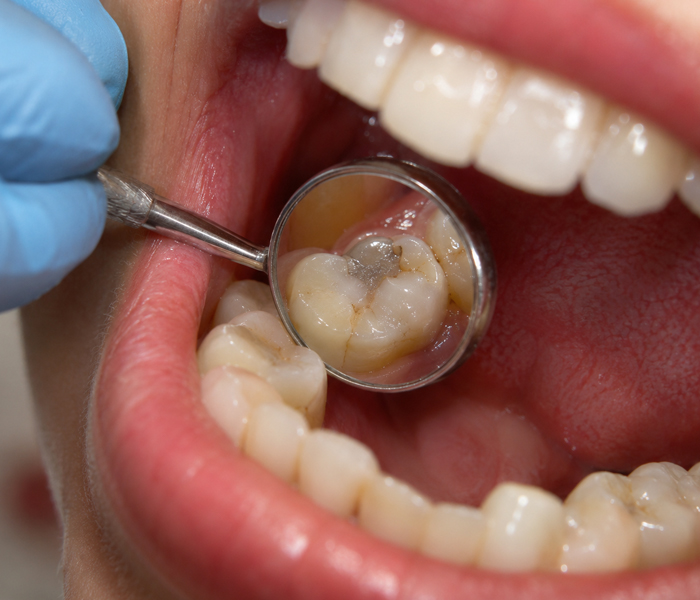
Can decay reappear in the same tooth years after a dental filling? Yes. In a tooth that has been previously treated, new decay can develop at the edge of the existing filling or in the adjacent tooth tissue. This condition is referred to as secondary decay or recurrent decay in dentistry. Moreover, even if the filling appears intact from the outside, the surrounding natural tooth tissue might have been damaged.
The important thing is not to consider every old filling risky, but to know which changes require a check-up. Problems detected early can sometimes be treated with more conservative methods, while advancing decay may require more extensive procedures.
What is Secondary Decay?
Secondary decay is a new carious lesion that develops on the surfaces of a tooth adjacent to a restoration, where a filling or other restoration has been previously applied. It is commonly described as “decay under the filling” by the public.
The filling material itself does not decay. Decay develops in the natural enamel and dentin tissues surrounding the material. In some cases, it can also progress in the area between the tooth and the restoration.
Here, it is necessary to differentiate between secondary decay and residual decay. Residual decay refers to the affected tissue left in the tooth during filling. Especially in deep cavities, controlled retention of certain tissues to protect the pulp can be part of current treatment approaches.
The scientific review in Clinical Oral Investigations journal emphasizes that the patient’s caries risk and the condition of restoration margins are important in the formation of secondary decay.
Why Does Decay Form Under an Old Filling?
There isn’t just one reason why decay might develop around a filling. The oral environment, personal hygiene habits, and the characteristics of the restoration can all play a role.
- Plaque accumulation: Bacterial plaque accumulated at the edges of the filling can increase acid production, leading to mineral loss in the natural tooth structure.
- Poor marginal fit: Gaps or irregularities around the restoration can make plaque removal difficult.
- Inadequate oral hygiene: Particularly, insufficient cleaning between teeth can increase the risk of decay.
- Frequent sugar consumption: Repeated consumption of sugary foods and drinks throughout the day increases the duration of acid attacks on teeth.
- Dry mouth: A reduction in the protective effect of saliva can facilitate the development of decay.
- Damage to the restoration: Broken or worn edges can, in some cases, create areas conducive to food and plaque accumulation.
However, not every gap or discoloration seen at the edge of a filling signifies active decay. A clinical examination is required to evaluate this.
How to Tell if There is Decay Under a Filling?
Recurrent decay can sometimes progress without any symptoms. However, in some patients, the following changes may be noticeable:
- New onset sensitivity to hot or cold in the filled tooth,
- Aching sensation when consuming sweet foods,
- Dark colored areas around the filling,
- Dental floss constantly getting stuck at the same spot,
- Recurrent food impaction between two teeth,
- Sensitivity or pain during chewing,
- Feeling a fracture or roughness at the edge of the filling.
All of these symptoms can also be seen in different dental problems. Especially, discoloration alone does not constitute a diagnosis of decay. Superficial staining at the edge of a filling must be distinguished from active decay.
You can also review our article on fracture of the edge of a filled tooth regarding physical damage around fillings.
Is Decay Under a Filling Visible on an X-ray?
Dental X-rays help in evaluating some decays, especially those on the interproximal surfaces of teeth and in the vicinity of restorations. When necessary, interproximal X-rays called bitewings can be utilized.
However, not all secondary decays are seen with the same clarity on X-rays. The restoration material, the location of the decay, and the size of the lesion can affect the interpretation of the image.
A systematic review and meta-analysis evaluating 25 studies published in the Journal of Dentistry in 2025, reported that the methods used for detecting secondary decay alone do not achieve sufficient diagnostic accuracy.
Therefore, the dentist evaluates visual examination, the marginal integrity of the restoration, the patient’s risk of decay, existing complaints, and necessary radiographic findings together.
If There is Decay, Must the Old Filling Be Replaced?
In every case, the filling does not necessarily have to be completely removed. The choice of treatment depends on the extent of the decay, the intact portion of the filling, and the loss of tooth structure.
For limited problems: In suitable cases, only the damaged part may be repaired, a small area may be restored, or different protective procedures may be considered.
For widespread caries: Complete removal of the existing restoration and re-restoration of the tooth may be necessary.
For advanced substance loss: Instead of standard fillings, methods such as inlays, onlays, or crowns may come into question.
Updated FDI criteria for the clinical evaluation of restorations explain the assessment of follow-up, surface adjustment, improving marginal sealing, repair, and replacement options in treatment decisions.
You can find detailed information about the scope of filling repair in our guide on restorative dental treatment.
What Happens If Caries Under a Filling Progresses?
Untreated active caries can lead to further loss of tooth tissue over time. The deepening lesion can affect the living tissue of the tooth called the pulp, and in some cases, lead to infection.
However, the detection of deep caries does not automatically mean that root canal treatment will be performed. The condition of the pulp, clinical symptoms, and the tooth’s restorability should be examined together.
On this topic, you can read our content titled when does a carious tooth require root canal treatment.
How Can Secondary Caries Formation Be Prevented?
To protect existing fillings, it is not enough to rely solely on the durability of the filling. Protecting the surrounding natural tooth tissue is also important.
- Brush your teeth twice a day with fluoride toothpaste.
- Clean between your teeth with dental floss or appropriate interdental cleaning tools.
- Reduce the frequency of consuming sugary snacks.
- If you experience dry mouth, ensure its cause is evaluated.
- Do not neglect any fractures or sensitivities you notice in filled teeth.
- Have check-ups at intervals recommended by your dentist.
For more information on methods that reduce the risk of decay, you can review our article on dental caries prevention and fluoride applications.
How Are Old Fillings Evaluated at Melsadent?
At Melsadent Oral and Dental Health Polyclinic, serving in Tuzla, the evaluation of old fillings takes into account the patient’s complaints, the condition of the restoration, and the overall health of the tooth. When deemed necessary, appropriate treatment options are planned by utilizing radiographic examinations.
The aim is not only to replace the old filling but also to preserve as much healthy tooth tissue as possible. If you notice discoloration, a fracture, or newly emerging sensitivity around your filling, you can create an examination request from the Melsadent online appointment page.
Frequently Asked Questions
Does decay under a filling necessarily cause pain?
No. Early-stage decay may not show symptoms. The absence of pain does not mean that the tooth tissue around the filling is completely healthy.
Does a 10-year-old dental filling have to be replaced?
No. The age of the filling alone is not a reason for replacement. The decision is made by evaluating marginal adaptation, presence of decay, fractures, and the patient’s complaints.
Is the black discoloration at the edge of the filling decay?
Not always. Superficial discolorations can also appear dark. Whether it is active decay is determined by clinical examination and necessary investigations.
Can secondary decay heal on its own?
The progression of some early lesions without cavitation can be stopped with preventive treatments. However, restorative treatment may be required for decayed areas where a cavity has formed and progressed.
Can decay form under a composite filling?
Yes. Decay can also develop in the natural tooth tissue surrounding composite fillings. The risk depends not only on the filling material but also on oral hygiene and the patient’s risk of decay.
Can decay be cleaned without removing the old filling?
In some limited and accessible lesions, localized repair can be performed without removing the entire filling. However, in widespread decay, the restoration may need to be replaced.
My filled tooth doesn’t hurt, should I still get it checked?
Yes. Regular check-ups help evaluate asymptomatic decay and restoration problems. The frequency of check-ups should be determined based on individual caries risk.
Does decay under a filling lead to tooth extraction?
In some teeth with advanced tissue loss, extraction may be necessary. However, many teeth can be preserved with appropriate restorative or endodontic treatments. The decision is made based on the tooth’s salvageability.